- Products
-
Shops
AI Search
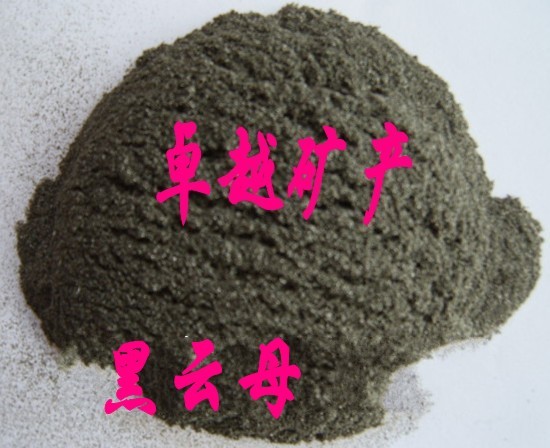
The main specifications of black mica produced by our factory include: 20 mesh, 40 mesh, 60 mesh, 80 mesh, 100 mesh, 200 mesh, 325 mesh, 400 mesh, 500 mesh, 600 mesh, 800 mesh, 1000 mesh, 1250 mesh, and 2500 mesh.
Chemical composition of biotite: K(Mg,Fe2+)3(Al,Fe3+)Si3O10(OH,F)2, with extensive isomorphous substitution, resulting in significant variations in the chemical composition of biotite from different rock types. Generally, biotite in acidic and alkaline igneous rocks has high FeO and low MgO; in basic and ultrabasic rocks[1], biotite has high MgO and low FeO; in alkaline pegmatites, biotite has low MgO but relatively higher Fe2O3.
The crystal form of biotite is the same as that of phlogopite. Its color is black or dark brown, sometimes with a slight reddish, greenish, or other hues. Those with high titanium content appear light reddish-brown, while those rich in ferric iron appear green. It ranges from transparent to opaque. It has a vitreous luster, with black varieties exhibiting a submetallic luster. Its hardness is 2–3, and its specific gravity ranges from 3.02 to 3.12. Under the action of hydrothermal solutions, biotite can be altered into other minerals such as chlorite, muscovite, and sericite. Due to its high iron content, biotite has poor insulating properties, far inferior to those of muscovite. Fine flakes of biotite are often used as filler in building materials. Biotite with larger grain sizes is easily identified by its flaky form, darker color, elasticity, complete cleavage characteristic of mica, and the slight magnetism it may exhibit when heated. In plutonic and hypabyssal rocks, especially in acidic or slightly alkaline rocks, biotite is commonly present.
Biotite is a type of mica mineral, belonging to the silicate mineral group. It is primarily found in metamorphic rocks, as well as in some other rocks such as granite. Biotite exhibits colors ranging from black to brown, red, or green, and has a vitreous luster. Its shape is tabular or columnar. In recent years, biotite has also been widely used in decorative coatings such as real stone paint.