- Products
-
Shops
AI Search

Quantum dots, due to their small particle size (1-20 nm), possess uniquely superior optical, electronic, and surface-modifiable properties. They have emerged as a rising star in the field of nanobiophotonics and are widely used in biological labeling. High-quality quantum dot solutions exhibit the following characteristics: a broad size range, narrow size distribution, good stability, and high fluorescence.
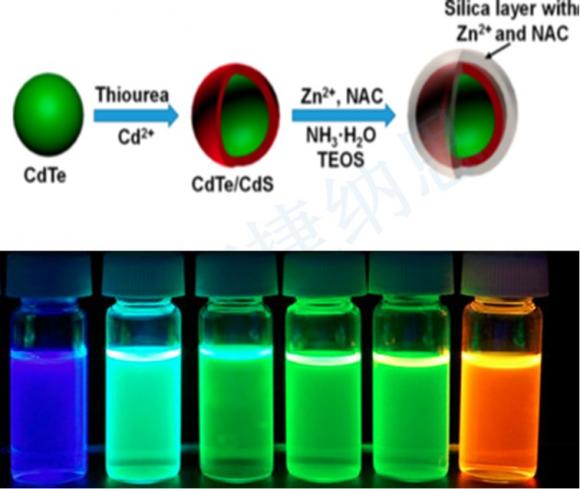
Quantum dots, due to their small particle size (1-20 nm), possess unique and superior optical, electronic, and surface-modifiable properties. They have emerged as a rising star in the field of nanobiophotonics and are widely used in biological labeling. High-quality quantum dot solutions exhibit the following characteristics: a broad size range, narrow size distribution, good stability, and high fluorescence. Because of their small size and large surface area, the fluorescence properties of quantum dots are highly susceptible to environmental influences. The large specific surface area of quantum dots results in a significant number of surface states, which in turn affect their fluorescence properties. Coating with organic or inorganic shells can effectively improve the fluorescence properties of quantum dots, enhance quantum efficiency, boost photoelectric effects, improve biocompatibility, and reduce biological toxicity.
Single-core
Water-soluble CdTe quantum dots
Single-core water-solubleCdTeQuantum Dots (Carboxyl/Amino Modified)
Water-solubleCdSQuantum dots
Oil-solubleCdTeQuantum dots
Oil-solubleCdSeQuantum dots
Oil-solubleCdSQuantum dots
Dual-core
Water-soluble CdTe/CdS quantum dots Water-soluble CdTe/ZnS quantum dots
Oil-solubleCdSe/ZnSQuantum dots
Oil-solubleCdZnS/ZnSQuantum dots
Three cores
Water-solubleCdTe/CdS/ZnSQuantum dots Water-solubleCdTe/ZnS/CdS Quantum dots