- Products
-
Shops
AI Search

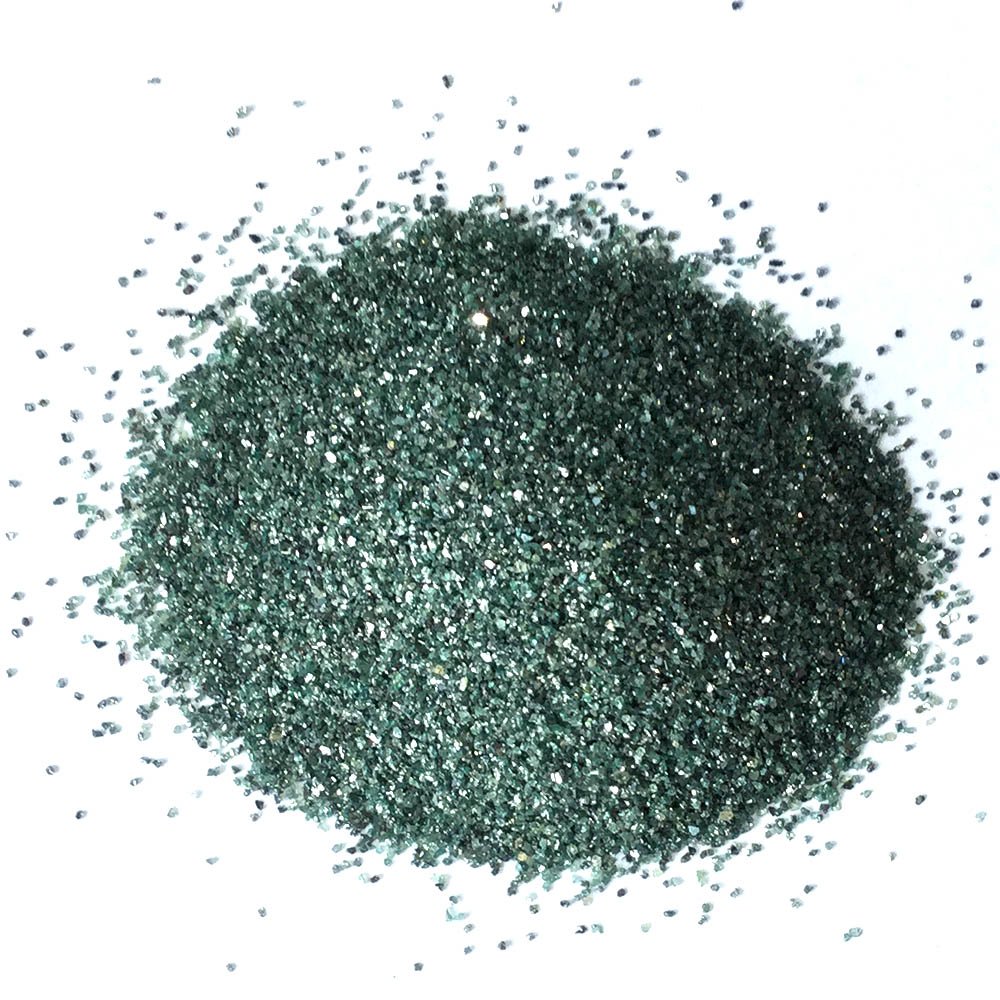
First-grade Green Silicon Carbide Abrasive Sand 36 Mesh 40 Mesh 46 Mesh
Green silicon carbide is primarily produced using petroleum coke and high-quality silica as raw materials, with salt added as an additive, and is smelted at high temperatures in a resistance furnace. It appears as green crystals, is brittle and sharp, and possesses certain thermal and electrical conductivity. Its microscopic shape is hexagonal crystals. The Mohs hardness of silicon carbide is 9.4, the microhardness is 2940–3300 kg/mm², and the Knoop hardness is 2670–2815 kg/mm². Among abrasives, it is harder than corundum but second only to diamond, cubic boron nitride, and boron carbide. Its density is generally considered to be 3.20–3.25 g/cm³. The natural bulk density of silicon carbide abrasive is between 1.2 and 1.6 g/cm³, with a specific gravity of 3.20–3.25 g/cm³.
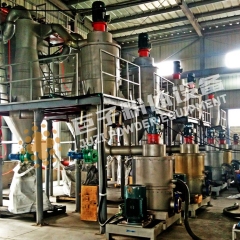
Green silicon carbide micropowder is produced by crushing high-quality large-crystal silicon carbide blocks, followed by particle shaping in a vertical ball mill, acid washing and moisture removal, precise hydraulic classification, natural sedimentation, and high-temperature drying. It features stable quality, good crystallization, high surface cleanliness, no large particles, minimal fine particle content, concentrated particle size distribution, and high grinding efficiency. It is suitable for various precision grinding processes, resulting in uniform and scratch-free workpiece surfaces.
Green silicon carbide spherical sand and micropowder are products that have undergone secondary shaping via a Raymond mill. They feature fewer angular edges on particles, good hydrophilicity, and are characterized by high grinding efficiency and long working life.
Performance characteristics of first-grade green silicon carbide abrasive grains in 36, 40, and 46 mesh sizes:
1. Silicon carbide has very strong oxidation resistance.
When heated to 1000 degrees Celsius in air, silicon carbide oxidizes only on the surface, forming a layer of silicon dioxide film that protects the silicon carbide material from further oxidation.
When heated to 1300°C, the silicon dioxide thin film layer begins to precipitate cristobalite. The crystalline phase transformation causes the thin film layer to crack, and the oxidation rate increases slightly.
When heated to 1500-1600 degrees Celsius, the silicon dioxide film layer thickens, enhancing its oxidation resistance, which allows silicon carbide to maintain stability at high temperatures. Only when heated above 1627 degrees Celsius does the oxidation resistance of silicon carbide rapidly decline.
2. Silicon carbide has strong chemical stability.
The chemical stability of silicon carbide is also due to its oxidation resistance.
3. The hardness of silicon carbide.
The hardness of silicon carbide falls between that of corundum and diamond. Black silicon carbide has a Mohs hardness of 9.2-9.3, while green silicon carbide has a Mohs hardness of 9.4-9.5, with a Vickers hardness of 3100-3400 kg/mm². The hardness of silicon carbide decreases as temperature increases; at a high temperature of 1200°C, its hardness can reach twice that of corundum.
4. Toughness of Silicon Carbide
The toughness of silicon carbide abrasive refers to the difficulty of breaking under external force. Taking 46 mesh as an example, the toughness tested by the static pressure method is approximately 68-78%.
The mechanical strength of silicon carbide is higher than that of corundum. Taking a 120-mesh particle size as an example, the compressive strength of silicon carbide is 186 KN/cm², while that of corundum abrasive is 100 KN/cm².
5. The color of silicon carbide.
Silicon carbide is divided into black silicon carbide and green silicon carbide. Its color is caused by the content and type of impurities present in the crystal. Black silicon carbide appears light blue-black, with a purity of 98% for first-grade black silicon carbide; green silicon carbide appears green, with a purity of 99% for first-grade green silicon carbide.
6. Thermal conductivity and linear expansion coefficient of silicon carbide
Thermal expansion coefficients of silicon carbide at different temperatures (x10⁻⁶/℃):
100-500 | 100-900 | 15-1000 | 25-1700 | 20-1000 | 20-1525 | 20-1000 | 20-1470 |
4.1 | 4.47 | 4.35 | 4.3 | 5.2 | 4.9 | 4.3 | 4.5 |
It can be seen that at temperatures between 25 and 1400 degrees Celsius, the average thermal expansion coefficient of silicon carbide is 4.4x10⁻⁶/°C, while that of corundum is 7-8x10⁻⁶/°C.
7. The electrical conductivity of silicon carbide
Due to the introduction of impurities, silicon carbide exhibits semiconductor properties. Its conductivity increases rapidly with the rise in electric field strength, demonstrating nonlinear characteristics. Additionally, the conductivity of silicon carbide also varies with changes in temperature.
Chemical composition:
SiC | 99.05% |
SiO2 | 0.20% |
F,Si | 0.03% |
Fe2O3 | 0.10% |
F.C | 0.04% |
Physical Properties:
Mohs hardness | 9.4 |
Specific gravity | 3.2g/cm3 |
Bulk density | 1.2-1.6 g/cm3 |
Color | Green |
Particle shape | Normal: Angular, irregular Spherical: The particles are round and well-formed.
|
Melting point | 2600 ℃ Free |
**Operating Temperature | 1900℃ |
First-grade green silicon carbide abrasive sand, 36 mesh, 40 mesh, 46 mesh, application scenarios:
1Precision polishing of hard optical glass such as camera lenses.
2.Sandblasting and sharpening of CNB tools made from hard metals such as titanium alloy and cemented carbide.
3.Polishing and grinding quartz glass.
4Grinding hard stone, marble, granite, etc.
5.Polishing PZT/piezoelectric ceramics.
6.Sandblasting copper and copper alloys.
7.Surface treatment of diamond tools.
9.Polishing jewelry such as diamonds and cinnabar.
10.Grinding precision parts made of other thin and brittle materials.
11.Fire-resistant novel nano aerogel.
12.Sintering ceramic and other fireproof insulating materials.
13.Teflon coating (added to Teflon non-stick pan coatings), fluorocarbon powder coating. Provides wear resistance, corrosion resistance, and high-temperature resistance.
15.High-quality brake additives for aviation aircraft brakes, etc.
16.Silicon carbide ceramic filler.
17.Polishing tools such as diamond polishing pads, PVC polishing pads, etc.
18.Wear-resistant, corrosion-resistant, and high-temperature resistant coating.