- Products
-
Shops
AI Search

Rapid economic development has led to a continuous increase in the discharge of domestic and industrial wastewater. Sludge is the solid sediment obtained during the purification of wastewater in treatment plants. It contains solid particles such as sand, fibers, and plant and animal residues mixed into domestic or industrial wastewater, along with their coagulated flocs. Sludge is a complex combination of various colloids, organic matter, adsorbed metal elements, microorganisms, bacteria, and worm eggs. Its composition is highly complex, highly variable, rich in organic matter, and prone to decomposition and odor. It is evident that if the sludge generated during domestic wastewater treatment is not properly handled and disposed of, it can cause significant damage to the surrounding environment, including water bodies, soil, and atmosphere in the disposal area, as well as pose certain health risks to nearby residents and animals. Proper disposal of sludge to achieve reduction, stabilization, harmlessness, and resource utilization has become a global concern. Sludge is a byproduct of the wastewater treatment process, and sludge dewatering is a critical step in sludge treatment.
Activated sludge is a flocculent particle formed by the mixing of microorganisms such as bacteria and protozoa with suspended and colloidal substances, possessing a strong ability to adsorb and decompose organic matter. This flocculent structure has excellent settling properties, allowing the treated water to separate from the sludge, ultimately achieving the goal of wastewater purification.
It is emphasized here that a major characteristic of sludge drying is that, as the drying process progresses, the sludge enters a gel-like phase, also known as the "sticky phase." At this stage, when ordinary dryers are used to dry activated sludge, the dry matter content of the sludge ranges from 45% to 60%. During this phase, the sludge tends to adhere to the walls of the dryer, leading to a reduction in drying efficiency and even potential damage to the equipment.
Changzhou Haomai Drying Engineering Co., Ltd. has effectively addressed this issue through corresponding technical measures and design in its professionally manufactured sludge twin-shaft paddle dryer. Moreover, this sludge twin-shaft paddle dryer can meet the needs of industries such as printing and dyeing, papermaking, biotechnology, electroplating, thermoelectric power, chemical processing, and wastewater treatment plants. Generally, the initial moisture content of dewatered sludge is around 80%, and after drying, the final moisture content ranges from 10% to 50%, with the industry standard for general sludge being approximately 30%. The dried sludge produced by the twin-shaft paddle dryer is in a loose, granular form and can be mixed with coal powder for direct combustion in boilers. The calorific value of the sludge is approximately 1500-2000 kcal, enabling waste utilization and energy savings. Additionally, the dried sludge can be processed into fertilizers or building materials, or directly landfilled without causing secondary pollution, turning waste into valuable resources and fully meeting environmental protection requirements.
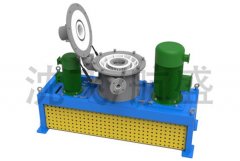
Principle of Activated Sludge Dryer: Wedge-shaped hollow paddles are densely arranged on the hollow shaft. The heat medium, thermal oil, flows from the hollow shaft through the paddles, providing a high heat transfer area per unit effective volume. The heat transfer medium flows through the rotary joint into the shell jacket and the hollow stirring shaft. The hollow stirring shaft has different internal structures depending on the type of heat medium to ensure optimal heat transfer efficiency.While the blades and jacket are heated by introducing a thermal medium, moisture is simultaneously extracted from the upper part of the discharge outlet, significantly enhancing the drying efficiency of the machine. The evaporated moisture is carried out of the drying equipment by the moisture extraction fan.
Features of the Activated Sludge Dryer: The sludge double-paddle dryer designed and produced by Haomai features low energy consumption, and the heat source can utilize steam, thermal oil, hot air, flue gas, etc. for heating (evaporating 1 kg of water consumes 1.1 to 1.3 kg of steam). It offers advantages such as low power consumption, stable operation, low noise, and minimal labor requirements, and is essentially fully automated in production.
**Engineering Case Studies**
Suzhou Dongwu Fuel Co., Ltd. is currently one of the world's leading producers of alkaline cationic fuel, with an annual output of 10,000 tons. It is worth noting that Dongwu does not solely pursue economic benefits; it also places great emphasis on environmental protection. The wastewater generated from daily operations is treated to meet discharge standards, while the heat produced during the drying process and the dried sludge are reused in other production activities, fully embodying the principles of circular economy and sustainable development.
Design parameters:
Sequence Number | Item | Parameters |
1 | Initial moisture content | ω1=50% |
2 | Final moisture content after drying | ω2=10% |
3 | evaporation amount | WWater=230kg/h |
4 | Output per unit time | WProduction=500kg/h |
5 | Feed liquid flow rate | |
6 | Ambient temperature | t0=15℃ |
7 | Feed temperature | θ1 =15℃ |
8 | Inlet air temperature | t1=150℃ |
9 | Outlet air temperature | t2=70℃ |
10 | The temperature of the product leaving the drying chamber | θ2=50℃ |
11 | Ambient air moisture content | d=0.01kg water/kg dry air |
12 | Specific heat of bone-dry product | Cs=0.4kcal/kg.℃ |
13 | Heat transfer area | 50 square meters |
14 | Total volume | 3.5m³ |
15 | Device dimensions | Length * Width * Height: 9.5m * 3.9m * 3.5m |
16 | Speed | 5-10rpm |