- Products
-
Shops
AI Search

The jet mill grinding of silicon carbide can precisely control the particle size within the range of 3 to 100 microns (d97), offering good particle shape and narrow distribution, making it suitable for high-demand applications. The fluidized bed jet mill features no lining wear, is clean and environmentally friendly, and is highly efficient with energy savings. By optimizing process parameters, it can adapt to raw materials of varying hardness.
The particle size range of silicon carbide crushed by an air jet mill.
Typical particle size: The particle size distribution of silicon carbide crushed by a fluidized bed jet mill is concentrated, with no over-grinding phenomenon. The fineness of the crushed material can typically reach d97: 3 to 100 microns.
Particle Shape and Distribution: The crushed silicon carbide has a good particle shape and a narrow particle size distribution, making it suitable for applications with high requirements for particle size.
Factors Affecting Crushing Particle Size
Device Type:
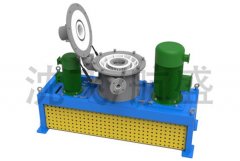
Fluidized Bed Jet Mill: It accelerates material particles using high-pressure gas, causing them to impact and collide at the intersection of nozzle jets to achieve pulverization. It offers strong crushing capability and precise particle size control.
Flat-type disc jet mill: It utilizes a swirling jet in the crushing chamber to drive materials in a circulating motion, where particles are crushed through mutual impact, collision, and friction with the machine body and among themselves. However, its particle size control may be slightly inferior to that of a fluidized bed jet mill.
Process parameters: including airflow pressure, nozzle velocity, classifier speed, etc. These parameters directly affect the crushing efficiency and particle size distribution.
Raw Material Characteristics: Properties such as the hardness and purity of silicon carbide also affect the crushing efficiency. Generally, silicon carbide with higher hardness and purity is more difficult to crush, but through optimized process parameters, an air jet mill can still achieve efficient crushing.
The advantages of jet milling for silicon carbide include:
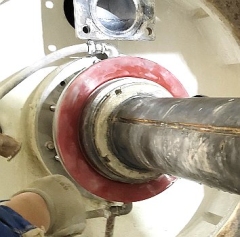
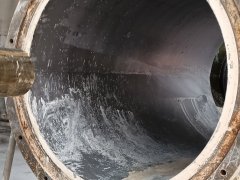
No-liner wear: The fluidized bed jet mill can grind products of various hardnesses without requiring a liner, resulting in low wear rate of machine parts, making it suitable for long-term continuous production.
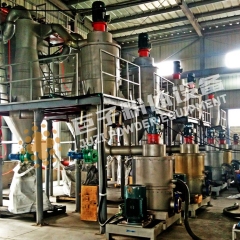
Clean and environmentally friendly: The entire system is sealed for crushing, resulting in minimal dust and low noise, ensuring a clean and eco-friendly production process.
High efficiency and energy saving: The energy provided by the gas in the jet mill is almost entirely used for short-range acceleration of materials, resulting in strong crushing capability and relatively low energy consumption.

| Purchasing Unit Region | Purchasing Unit Name | Purchase Time | Number of units purchased | Applicable Fields |
| Henan | Henan Kesheng Abrasive Materials Co., Ltd. | 2024-06-03 | Two sets | Oil/Chemical |