- Products
-
Shops
AI Search

Key equipment for the production of ternary materials
1. Compounding Equipment
In the production of ternary materials, batching and mixing involves adding stoichiometric ratios of lithium salts, precursors, and additives into mixing equipment for uniform blending. The uniformity of this process affects the distribution of lithium and additives during sintering, directly influencing the crystallinity and residual alkali content of the ternary material, ultimately reflected in its electrochemical performance.
The stability of the final lithium ratio in ternary materials depends on the accuracy of raw material weighing, while the uniformity depends on the mixing effectiveness of the blending machine.
Mixing is generally divided into wet mixing and dry mixing. Ternary materials typically useDry mixingCurrently, commonly used ternary material mixing equipment includes inclined mixers and high-speed mixers.V-type mixer, plow knife mixer, etc.
2. Sintering Equipment
Sintering equipment is the core equipment for the preparation of ternary materials, primarily referring to kilns, whose structure significantly impacts both the physical and electrochemical properties of ternary materials. Currently, the industrial production of ternary materials mainly employs pusher kilns and roller hearth kilns, with the latter being particularly prominent.Roller kiln* is widely used.
The sintering temperature of ternary materials is a critical process parameter that can affect most of the material's properties. Therefore, ternary materials require high stability and precision in kiln temperature, making the temperature control system essential for the sintering process.
3. Crushing Equipment
In the production of ternary materials, due to the agglomeration and adhesion between sintered material particles, crushing equipment is required to dissociate the sintered material, thereby controlling the particle size and its distribution. The particle size and its distribution affect the specific surface area, tap density, compaction density, processability, and electrochemical performance of ternary materials, making them crucial to the quality of the final ternary material product.
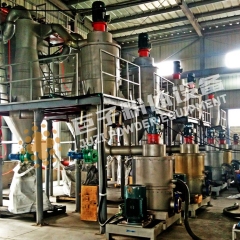
The crushing of ternary materials typically involves first coarse crushing the sintered material, followed by fine grinding. Coarse crushing equipment generally includes jaw crushers or roller crushers; fine grinding equipment commonly includes jet mills, mechanical mills, and colloid mills, among which fine grinding directly determines the degree of crushing of the ternary materials.


 4. Iron Removal Equipment
The metal impurities in ternary materials need to be controlled within tens of...ppb(1ppb=1×10⁻⁹m) level, excessively high levels of metal foreign objects can lead to a high self-discharge rate in the battery, and may even affect the battery's safety performance.
The metal impurities in ternary materials mainly originate from raw materials and equipment wear during the production process, and are primarily composed of magnetic metal impurities, especiallyIron (metal)Therefore, the production process requires one or even multiple rounds of iron removal from the finished product. Commonly used iron removal equipment includes electromagnetic iron removers and permanent magnet iron removers.
The development of the lithium battery industry is inseparable from the improvement of material quality. Currently, ternary materials are generally moving toward high-nickel directions. High-nickel ternary materials impose higher requirements on production processes, equipment, environment, and atmosphere. Production lines must achieve a high level of automation, with particular emphasis on strengthening temperature, humidity, and atmosphere control in production workshops. Industrial equipment for ternary materials will gradually evolve toward intelligence, high capacity, low energy consumption, and environmental friendliness, in order to meet the demands of power batteries for high-performance and low-cost ternary materials.