- Products
-
Shops
AI Search

**Product Introduction:**
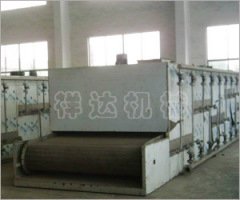
This series of dryers features fast drying speed, high evaporation intensity, and excellent product quality.
Product Detailed Introduction
Purpose:
Dehydrated vegetables, pellet feed, monosodium glutamate, chicken bouillon, desiccated coconut, organic pigments, synthetic rubber, acrylic fibers, pharmaceuticals, medicinal herbs, small wooden products, plastic products, aging and curing of electronic components, etc.
■ Large-scale continuous drying.
■ This series of dryers features fast drying speed, high evaporation intensity, and excellent product quality.
Working Principle:
■ The working principle is shown in the diagram. The material in the hopper is evenly spread onto the mesh belt by the feeder. The mesh belt, made of 12-60 mesh stainless steel wire mesh, is driven by the transmission device to move within the dryer. The dryer consists of several units, each with independent hot air circulation. A portion of the exhaust gas from each unit is discharged by a dedicated moisture exhaust fan 4, and the volume of exhaust gas from each unit is controlled by a regulating valve. In the upper circulation unit, the air from the circulation fan 5 enters the lower chamber of the unit through a side duct. The airflow passes upward through the heater 7 for heating, is distributed by the air distributor 6, and then blows onto the mesh belt as a jet stream. After passing through the material, it enters the upper chamber. The drying process involves the hot airflow passing through the material layer, completing the transfer of heat and mass. The upper chamber is connected to the fan inlet via an air duct. Most of the gas is recirculated, while a portion of the gas with lower temperature and higher moisture content is discharged as exhaust gas through the moisture exhaust pipe, regulating valve, and moisture exhaust fan. In the lower circulation unit, the air from the circulation fan first enters the upper chamber, then passes downward through the heat exchanger for heating, goes through the material layer, and enters the lower chamber. The lower chamber is connected to the fan via a side duct and a return air pipe. Most of the gas is recirculated, while a portion is discharged. The upper and lower circulation units can be flexibly configured according to user requirements, and the number of units can also be selected as needed.
■ For dehydrating vegetables, three units are generally used in series to form an initial drying stage, an intermediate stage, and a final drying stage. In the initial drying stage, due to the high moisture content and poor air permeability of the material, a smaller material layer thickness, faster operating speed, and higher drying temperature should be adopted. In the initial drying stage, the drying gas temperature can reach above 120°C. The material residence time in the final drying stage is 3-6 times that of the initial drying stage, and the material layer thickness is 2-4 times that of the initial drying stage. To meet the requirement that the material temperature does not exceed 60°C, a drying gas temperature of around 80°C can be used. Adopting a multi-stage combination can better leverage the performance of the belt dryer and achieve more uniform drying.