- Products
-
Shops
AI Search

【Feed Size】: ≤10mm 【Processing Capacity】: 35-370t/h
Application Fields
Sand and gravel yards, mining operations, coal mining, concrete batching plants, dry-mix mortar, quartz sand, etc.
Applicable materials
River pebbles, granite, basalt, iron ore, limestone, quartzite, diabase, construction waste, iron ore, gold ore, etc.
I. Product Overview
Sand and gravel are aggregates used in concrete, concrete products, and ordinary mortar in construction projects. The standard "GB/T 14684-2011 Sand for Construction" specifies that the fine particle content of different grades of construction sand must not exceed the required range.
In the past, sand production lines often used water washing to remove fine powders from sand particles. In recent years, due to environmental requirements or insufficient water supply at sand plants, dry sand washing equipment has been increasingly adopted to remove fine powders from sand particles, and the application of sand powder classifiers has become more widespread.
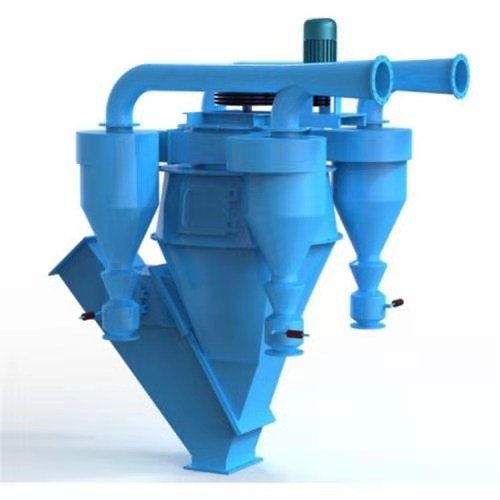
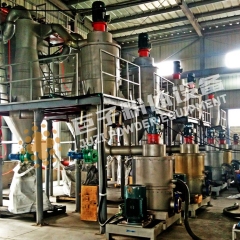
The sand and gravel classifier produced by our company adopts a combination of cascade and dynamic rotor classifiers for the classification of sand and gravel materials. The materials undergo two-stage classification inside the classifier: the **first stage** involves a non-powered cascade preliminary classification to separate fine particles from the material, while the **second stage** uses a dynamic rotor for precise fine powder particle size classification. Users can adjust the rotational speed of the dynamic rotor as needed to control the fineness of the classified powder.
This classifier is significantly different from previous classifiers.
In the past, classifiers typically fed material from the upper part, where the material was discharged onto a high-speed rotating rotor spreading plate for distribution and classification, or onto a high-speed rotating spreading impeller for the same purpose. Due to the high-speed rotation of the spreading device, it experienced rapid wear, often leading to issues such as deteriorated rotor balance and increased vibration. This resulted in heavy maintenance workloads and made the system particularly sensitive to occasional large stone particles mixed in with the fine sand material.
The sand and gravel classifier produced by our company uses a combination of a cascade flow and dynamic rotor classifier to separate sand and gravel materials. The material distribution is achieved through a non-powered cascade flow classification device. Since there are no high-speed rotating components, the wear of the primary classification equipment is well controlled, and it is insensitive to occasional mixed particles.
II. Outstanding Advantages
1. Sorting Principle
Static V-shaped cascade air classification is used for preliminary selection, offering wear resistance; a dynamic cage-type rotor is employed for precise particle size classification to control powder particle size.
2. Easy to operate
The dynamic cage rotor grading adopts variable frequency drive for stepless speed regulation, offering convenient, sensitive, and reliable quality adjustment with a wide adjustment range.
3. High classification efficiency
Based on the physical and chemical properties of the sand and gravel, expand the classification range to achieve more thorough material dispersion, thereby ensuring classification efficiency.
4. Wear-resistant design, maintenance-free.
The main components of this sorting machine, such as the disperser, fine material collector, and multi-channel distributor, are made of wear-resistant steel plates, effectively extending their service life. The entire machine has undergone dynamic balance calibration, ensuring stable operation across the full speed range.
5. The system employs double interlocking air valves and internal circulation air to effectively reduce air leakage and minimize dust emission pollution during operation.
III. Technical Performance