- Products
-
Shops
AI Search

I. Purpose
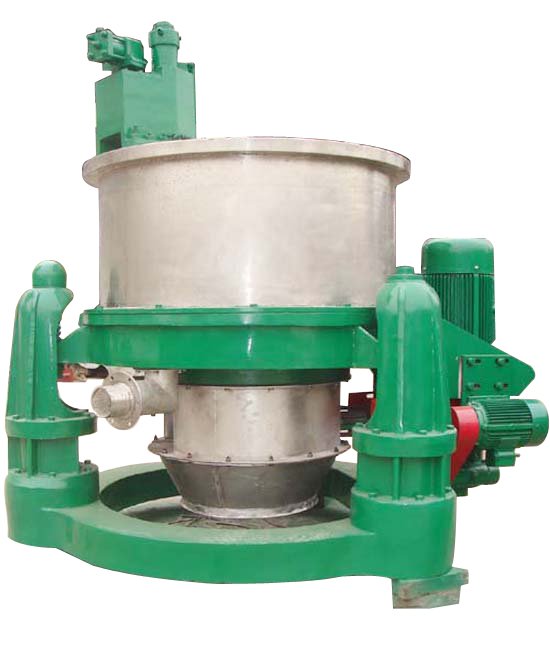
This machine is used for the production and separation of suspensions of **light calcium carbonate** and **dicalcium phosphate**. It is also suitable for solid-liquid separation in other industries such as chemical, light industry, wastewater treatment, coal washing, pharmaceuticals, and sugar refining.
II. Machine Structure
This machine is a centrifugal filtration separator with bottom discharge. The lower end of the main shaft is connected to the rotating drum, while the upper end is supported within the bearing housing. A vertical motor mounted on the frame drives the main shaft through a centrifugal friction clutch, and a band brake is installed on the main shaft. Due to this structure, the pivot point of the main shaft is positioned far from the center of gravity of the rotating body, and a flexible shaft with elastic support is adopted, significantly reducing the critical speed and minimizing mechanical vibrations caused by uneven material feeding. The machine uses a variable frequency drive to control the rotor speed, enabling low-speed startup to reduce starting current and impact force, while achieving high-speed dewatering with low moisture content in the filter cake, resulting in notable energy savings and consumption reduction. This machine operates smoothly, with low noise, stable performance, and high reliability.
III. Main Technical Parameters
Specifications and Model | XR-1000A | **Separation factor** | 804 |
Inner diameter of the drum (mm) | 1000 | 转鼓高度mm) | 710 |
Filtration area (㎡) | 2.23 | Effective Volume (L) | 280 |
Feeding speed (rpm) | 970 | Spindle **Speed (rpm) | 1200 |
Motor Power (KW) | 15 | **Charge Amount (kg) | 300 |
Overall Dimensions (mm) | 1920×1460×3023 | Weightkg) | 1800 |
IV. Comparison of Dewatering Effects Between Ordinary Centrifuges and Variable Frequency Speed Control Centrifuges
The starting current of the variable frequency speed control centrifuge is low, and under the same slurry concentration and dewatering cycle conditions, the moisture content of the dewatered material from the variable frequency speed control centrifuge is approximately 10 percentage points lower than that from a conventional centrifuge, resulting in significant energy savings. Taking an annual production of 10,000 tons of light calcium carbonate as an example, if a conventional rotary dryer is used, the coal consumption for drying is compared as follows:
Model | Moisture content of filter cake | Need filter cake | Dry the moisture. | Coal for drying | Light calcium carbonateOutput |
XR1000 | 38% | 16129ton | 6129ton | 1300ton | 10000ton |
XR1000A | 25% | 13333ton | 3333ton | 706ton | 10000ton |
Note: The above data may vary depending on the nature of the materials, the actual calorific value of the coal used for drying, and the thermal efficiency of the dryer used by the customer. Therefore, the above data is for reference only.