- Products
-
Shops
AI Search

Device Principle
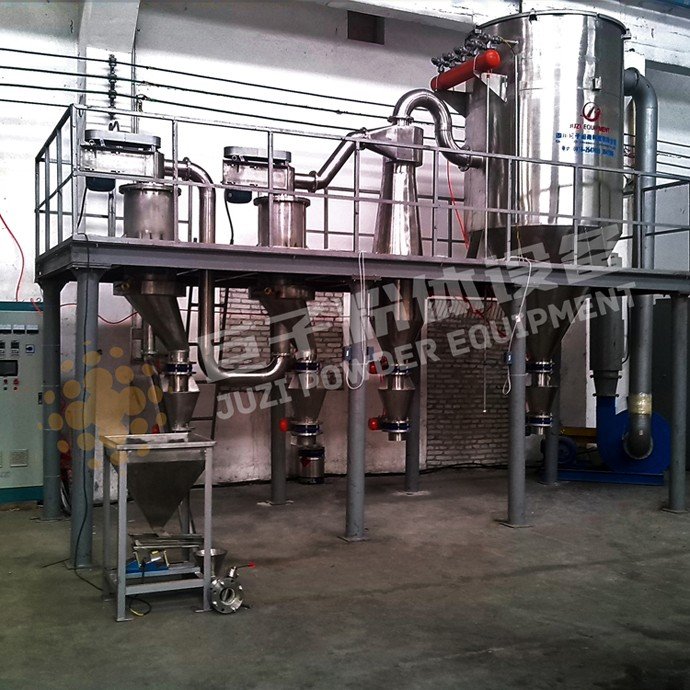
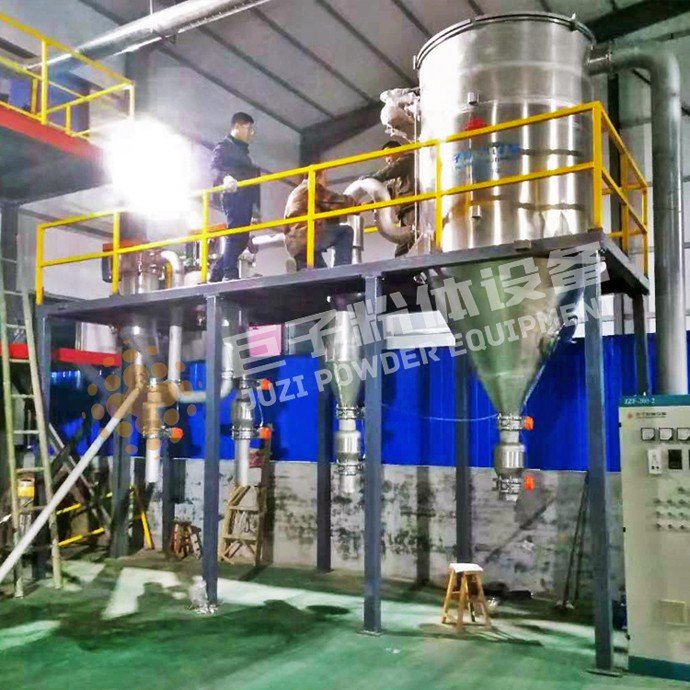
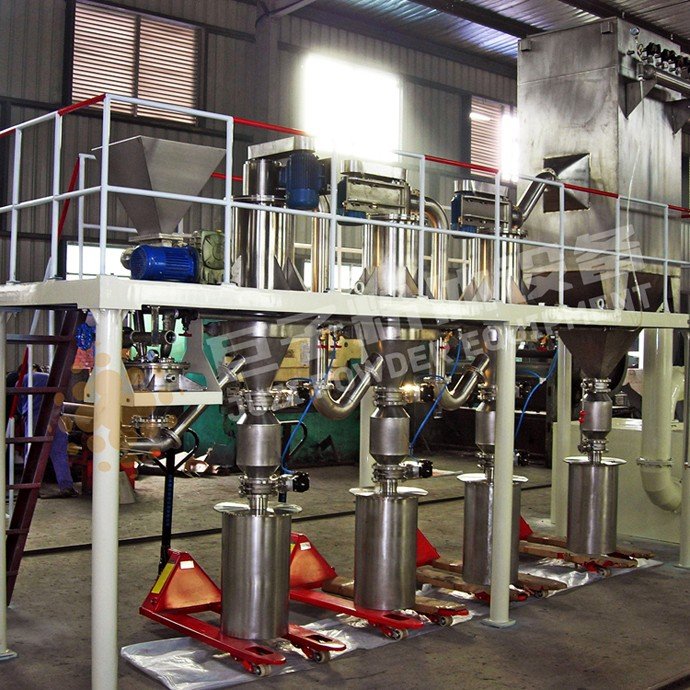
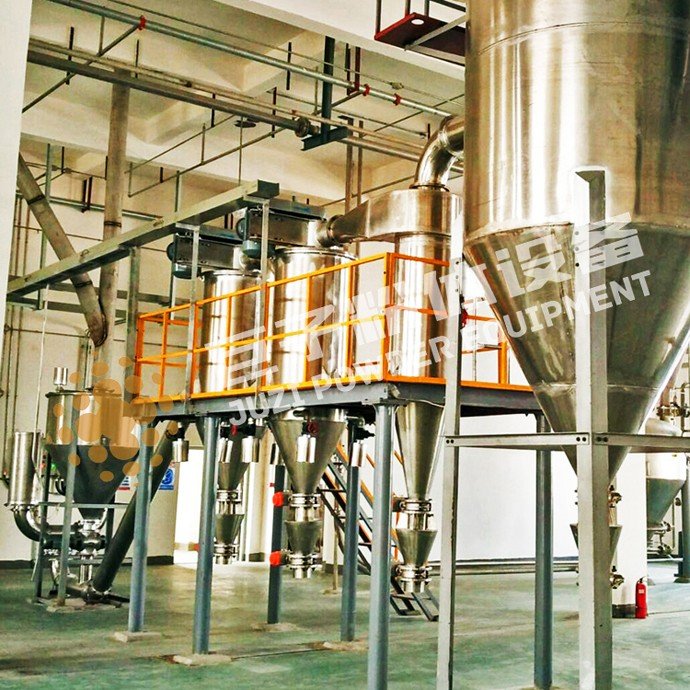
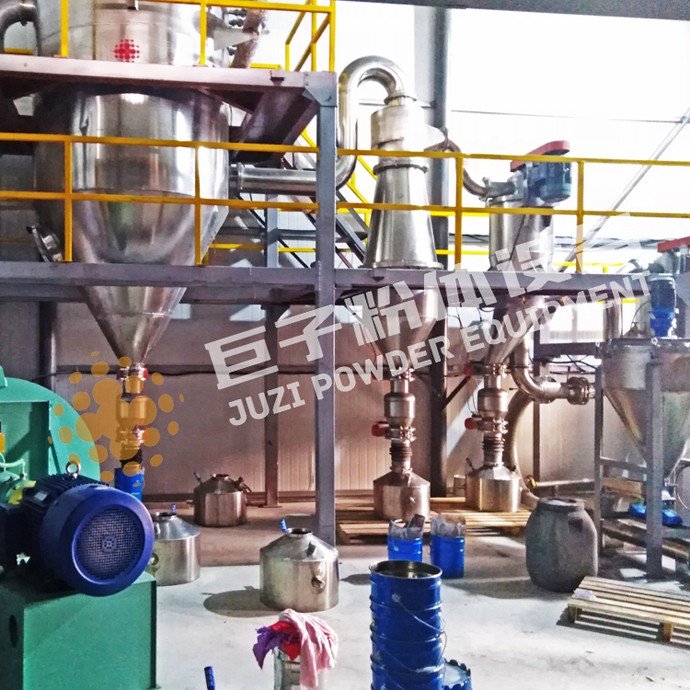
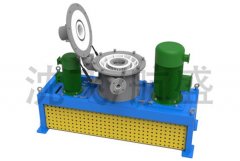
This airflow classifier is our company'sMain forceProduct: The vertical turbine classifier of this equipment is mainly composed of a motor, a classifier housing, and a classifier wheel. The motor drives the classifier wheel to rotate at high speed within the classifier housing (the rotation speed can be adjusted arbitrarily), generating a strong centrifugal force inside the classifier. The gas-powder mixture entering the classifier first goes inside the classifier wheel. Under the action of centrifugal force, large or heavy particles are subjected to greater centrifugal force, so they are thrown to the periphery of the classifier wheel and then to the wall of the classifier. No longer affected by centrifugal force, they naturally fall into the main crusher for further crushing or into the discharge port for collection. Small or light materials are less affected by centrifugal force, hovering inside the classifier wheel. Influenced by the induced draft fan, they are carried upward and move along the pipeline to the next component for classification or collection. By adjusting the rotation speed of the classifier wheel through frequency conversion, the magnitude of the centrifugal force in the classifier can be regulated, achieving the goal of separating materials with a specified particle size.
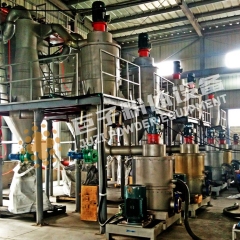
This series of air classifiers can also be equipped with multiple classifiers in addition to the standard vertical turbine classifier, allowing multiple finished product particle sizes to be produced simultaneously in a single processing flow. The particle size at each discharge outlet can be adjusted individually, and the proportion of output can be controlled as needed. The finished product particle size can be adjusted within a wide range. *Up to five classifiers can be added to form a five-unit system. Currently, only our company in China can research, develop, manufacture, and produce this system, and we have a large number of application customers.
The equipment can be made of carbon steel, stainless steel, or other specified materials. If lining is required, it can also be customized as needed.
Equipment Features
The main features of this air classifier are low energy consumption, high processing capacity, and flexible modular structure: it can be interchanged with a fluidized bed pulverizer to function as a pulverizing classifier; it can be combined with coarse crushers such as Raymond mills, ball mills, and roller mills to separate ultrafine powders, achieving low energy consumption and minimal pollution; it can also be directly connected to dryers, conveyors, automatic packaging machines, etc., to simplify the production process and steps.
Scope of Application
General Applications: Ultra-fine classification of materials that cannot be classified on ordinary sorting equipment, especially suitable for processing products with strict particle size requirements and narrow particle size distribution, such as ground calcium carbonate, kaolin, talc powder, barite powder, coatings, mica, graphite, auxin, aluminum hydroxide, etc.
Professional Application: Capable of classifying materials with extremely strict particle size requirements, while meeting the demands for purity and particle shape. Typical materials: copier toner, laser printer toner, mobile phone battery powder, industrial battery powder, etc.
High-purity applications: Capable of classifying materials with extremely strict impurity content requirements or materials highly sensitive to iron, while also meeting the requirements for particle size and particle size distribution. Typical materials: phosphors, titanium dioxide, starch, silica gel, aluminum, copper, luminescent powders, and various high-purity pigments.
Hard Materials: Capable of ultra-fine classification of hard materials with a Mohs hardness of seven or above. The application of a vertical turbine classifier ensures minimal equipment wear. The rotational speed of the classification wheel can be adjusted, and classification parameters can be optimized. When multiple classifiers are combined, narrow-band classification across several particle size ranges can be completed in a single pass. Typical materials: diamond, silicon carbide, garnet, corundum, and other ceramic materials.
This airflow classifier is suitable for the fine processing of high-purity, high-hardness, and heat-sensitive materials. It is applicable for ultrafine powder processing in industries such as abrasives, chemicals, and pharmaceuticals, and meets the application requirements for inert gas protection.
Equipment Display