- Products
-
Shops
AI Search

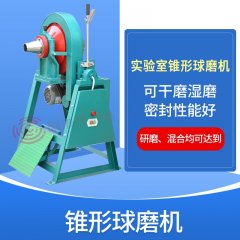
I. Overview of the Experimental Conical Ball Mill
This experimental ball milling equipment allows for arbitrary setting of grinding time and can be used for both dry and wet grinding. It employs frequency conversion technology, offering a wide speed adjustment range, making grinding, mixing, and homogenization convenient. The equipment requires no foundation treatment for installation, operates with low noise and low pollution, and is clean and easy to work with, featuring good grinding sealing performance. This machine is a small, lightweight, and versatile new type of grinding equipment for laboratory use. It is suitable for laboratories, research institutions, and mineral processing plants in fields such as metallurgy, geological chemistry, building materials, and coal, for fine grinding of ores during ore washability studies. This product features advanced performance, a reasonable structure, high sample preparation efficiency, and excellent sealing performance. It is suitable for the crushing and processing of various metal and non-metal ore raw material test samples. It can be used by production units in geology, mining, metallurgy, carbon, coal, building materials, and power sectors that require crushing and processing for laboratory tests. Additionally, it is applicable for ultra-fine grinding in the coatings, ink, fuel, and food industries. A ball mill is a key piece of equipment for further crushing materials after they have been initially broken. Ball mills are widely used in industries such as cement, silicate products, new building materials, refractory materials, fertilizers, ferrous and non-ferrous metal beneficiation, as well as glass and ceramics production, for dry or wet grinding of various ores and other grindable materials.
II. Working Principle of the Experimental Conical Ball Mill
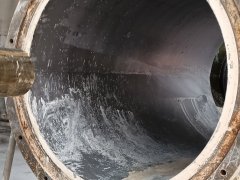
This ball mill is a horizontal cylindrical rotating device, driven by an external gear, featuring two chambers and a grid-type discharge. Material enters the first chamber of the mill evenly through the feeding device via the hollow shaft spiral. This chamber is lined with stepped or corrugated liners and contains steel balls of various specifications. As the cylinder rotates, centrifugal force lifts the steel balls to a certain height before they fall, delivering heavy impact and grinding action to the material. After coarse grinding in the first chamber, the material passes through a single-layer partition plate into the second chamber, which is lined with flat liners and contains steel balls for further grinding. The powdered material is discharged through the discharge grate plate, completing the grinding process.
III. Structural Characteristics of the Experimental Conical Ball Mill
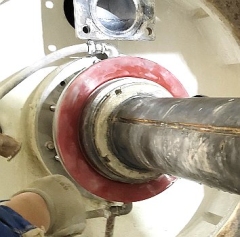
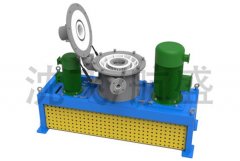
This machine mainly consists of the feeding part, discharging part, rotary part, and transmission part (reducer, small transmission gear, motor, electric control), among other key components. The hollow shaft is made of cast steel, with a replaceable inner lining. The large rotary gear is processed through gear hobbing of castings, and the inner surface of the cylinder is lined with wear-resistant plates, ensuring excellent wear resistance. The machine operates smoothly and reliably.
Technical Parameters:
Model | XMQΦ150×50 | XMQΦ240×90 | XMQΦ350×160 |
Give Ore quantity | 200g | 500~1000g | 4000g |
Feed particle size | ≤5mm | ≤5mm | ≤5mm |
Discharge particle size | 0.074mm | 0.074mm | 0.074mm |
Electricity Move machine | 0.75kw | 1.1kw | 1.1kw |
Overall Dimensions | 915*530*1160MM | 1052*640*1160MM | 700×575×1190mm |
machine Heavy | 150kg | 170kg | 300kg |
| Purchasing Unit Region | Purchasing Unit Name | Purchase Time | Number of units purchased | Applicable Fields |
| Guizhou | Guizhou Kehui Instrument Co., Ltd. | 2018-12-13 | 1 | Oil/Chemical |