- Products
-
Shops
AI Search

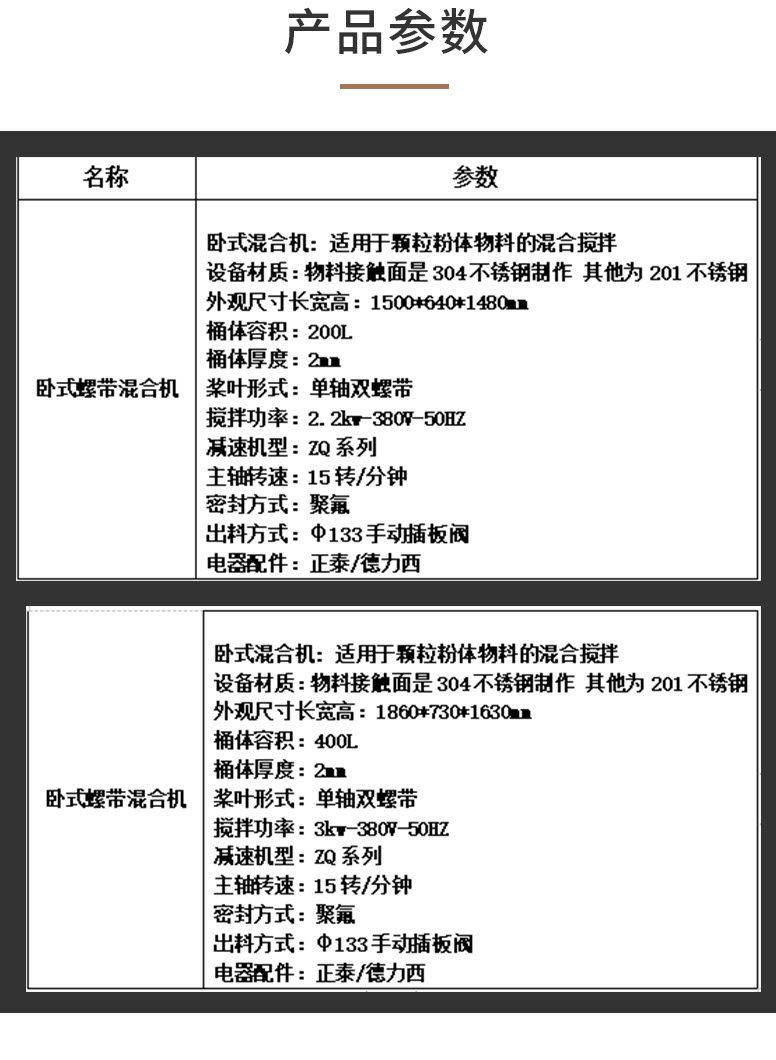
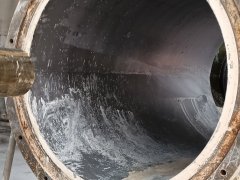
The main drive shaft of the horizontal ribbon mixer is equipped with double-layer spiral blades. The inner spiral conveys materials outward, while the outer spiral gathers materials inward. Under the convective motion of the double-layer spiral ribbons, the materials create a low-energy, high-efficiency mixing environment. The inner and outer diameter spirals installed on the mixing shaft drive the materials within the barrel, enabling the mixer to **extensively** agitate the materials inside the barrel. During operation, the inner spiral drives the materials near the shaft axis to rotate around it, pushing them axially from the center outward to both sides. Meanwhile, the outer spiral drives the materials near the barrel wall to rotate around the axis, pushing them axially from both sides inward. This mixing process ensures that the materials are uniformly blended in a relatively short time.
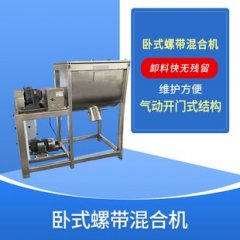
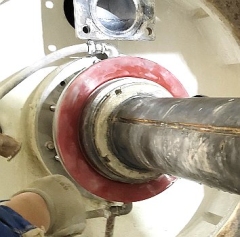
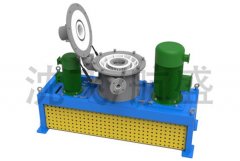
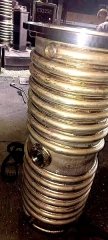
Bottom discharge method of the mixer: For powder materials, a pneumatic door opening structure can be used, offering advantages such as fast discharge and no residue. For high-fineness materials or semi-fluid materials, manual butterfly valves or pneumatic butterfly valves are used. Manual butterfly valves are economical and practical, while pneumatic butterfly valves provide better sealing for semi-fluids but have a higher cost than manual butterfly valves. In cases where heating or cooling is required, a jacket can be configured. Two heating methods are available: electric heating and thermal oil heating. Electric heating is convenient but has a slow temperature rise and high energy consumption. Thermal oil heating requires the configuration of an oil tank, oil power, and pipelines, which involves a larger investment, but it offers fast temperature rise and lower energy consumption. For cooling processes, cooling water can be directly injected into the jacket. The jacket has a large heat exchange area, resulting in fast cooling speed. The motor is directly connected to the stirring shaft via a cycloidal pinwheel reducer, providing a simple structure, high operational reliability, and easy maintenance.
Widely used in the mixing of solid-solid (i.e., powder to powder) and solid-paste (i.e., powder to adhesive slurry) materials such as putty paste, real stone paint, dry powder, putty, pharmaceuticals, food, chemicals, feed, ceramics, and refractory materials, it is especially suitable for mixing viscous materials. This mixer is not suitable for materials with high fiber content or significant density differences. For industries such as putty paste, real stone paint, biology, pharmaceuticals, and food, stainless steel material is recommended. Generally, for mixing dry powder mortar containing vitrified microspheres, the horizontal ribbon mixer is recommended for faster operation. The motor is directly connected to the main mixing shaft via a cycloidal pinwheel reducer, offering a simple structure, high operational reliability, and easy maintenance.
Material requirements
Based on the material conditions, users can choose from materials such as ordinary carbon steel and stainless steel. If the material is highly corrosive, a higher-grade stainless steel or an inner corrosion-resistant lining can be selected. Depending on the required surface treatment level, options include rough polishing, fine polishing, or mirror polishing.