- Products
-
Shops
AI Search

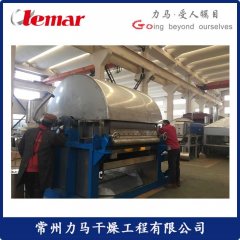
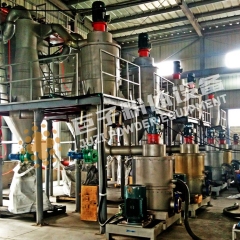
Aluminum Chloride Drum Scraper Dryer
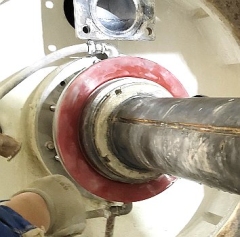
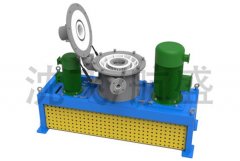
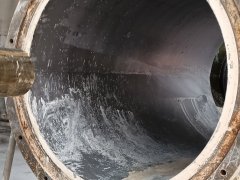
Roller scraper dryer, including a residue collection device for collecting residue. The residue collection device comprises a residue collection hopper, which is equipped with a pressure valve and a vacuum valve. The pressure valve includes a pressure valve disc and a pressure rod, and the pressure rod is connected to a pressure rotating block that drives the pressure rod to rotate around its axis. The vacuum valve includes a vacuum valve disc and a vacuum rod, and the vacuum rod is connected to a vacuum rotating block that drives the vacuum rod to rotate around its axis. The pressure rotating block and the vacuum rotating block are respectively hinged with a pressure swing rod and a vacuum swing rod. The pressure swing rod and the vacuum swing rod are hinged with the same linkage rod. The connecting line between the connection point of the pressure rod and the pressure rotating block and the connection point of the vacuum rod and the vacuum rotating block is parallel to the linkage rod, and the length of the connecting line is equal to the length of the linkage rod. The beneficial effect of the present invention is that the roller scraper dryer can simultaneously operate the pressure valve and the vacuum valve, thereby facilitating the adjustment of the air pressure in the residue collection hopper.
Aluminum chloride is a colorless transparent crystal or a white to slightly yellowish crystalline powder. In its vapor state, when dissolved in nonpolar solvents, or in a molten state, it exists in the form of covalent dimeric molecules (Al₂Cl₆). It is soluble in water and many organic solvents, with its aqueous solution being acidic. In the presence of aromatic hydrocarbons, aluminum chloride mixed with aluminum can be used to synthesize bis(arene) metal complexes. For example, dibenzenechromium is prepared via the Fischer-Hafner synthesis using specific metal halides.