- Products
-
Shops
AI Search

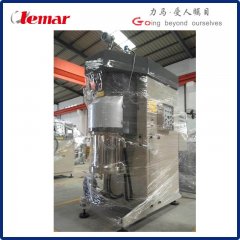
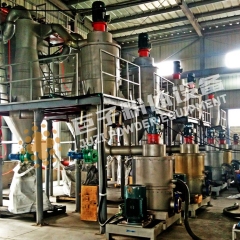
Vertical Sand Mill for Superhard Material Boron Carbide 1.5L
Boron carbide, with the molecular formula B4C, is typically a gray-black micro-powder. It is one of the three hardest known materials (the other two being diamond and cubic boron nitride) and is used in tank armor, bulletproof vests, and many industrial applications. Its Mohs hardness is 9.3.
It was discovered in the 19th century as a byproduct of research on metal borides, but it was not scientifically studied until the 1930s. Boron carbide can be produced by reducing boron trioxide with carbon in an electric furnace.
Boron carbide can absorb a large number of neutrons without forming any radioactive isotopes, making it an ideal neutron absorber in nuclear power plants. Neutron absorbers are primarily used to control the rate of nuclear fission. In nuclear reactors, boron carbide is mainly made into control rods, but sometimes it is ground into powder form to increase its surface area.
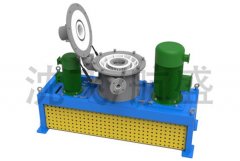
Boron Carbide Superhard Material Boron Carbide Vertical Sand Mill 1.5LFive Major Advantages:
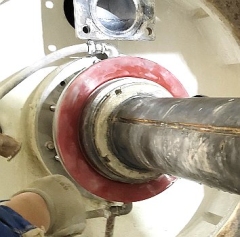
1. No shaft seal:No worries about leaks, damage, or repairs.
2. No sieve:No clogging, no need to clean the screen or screen beads;
3. Ultra-fine grinding media:Φ0.1-2.0mm (for some materials, Φ0.05mm beads can be used)
4. Efficient Grinding:The power is used for effective grinding of large particles, with efficiency improved by over 50% compared to traditional sand mills.
5. Classification and separation, classification and grinding functions:
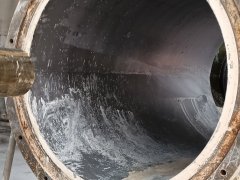
The function of centrifugal separation is to promptly discharge fine particles, ensuring a short residence time and preventing over-grinding.
Large particles that fail to be discharged remain in the grinding chamber for a longer period and are ground finer.
Thus, the final product has uniform particles and a narrow distribution.
6. Grinding range:100μm-50nm (nanoscale)
7. Applicable Equipment:Energy, electronics, inkjet, ceramics, carbon materials, minerals, metals, chemical industry
8. Equipment Model:0.5L、1.5L、5L、15L、30L、60L、100L