- Products
-
Shops
AI Search
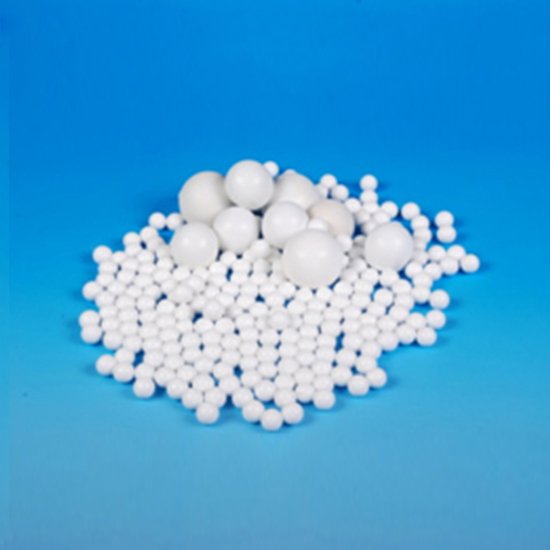
Performance of Microcrystalline Al2O3 Grinding Media
Grade | Al2O3 content | Density | Flexural strength | Equivalent wear |
LA92-45 | ≥92 | ≥3.60 | 280 | ≤0.1 |
LA92-16 | ≥92 | ≥3.65 | 310 | ≤0.05 |
LA92-11 | ≥92 | ≥3.65 | 310 | ≤0.01 |
LA99 | ≥99 | ≥3.90 | 350 | ≤0.05 |
Specifications:
Grinding Bead Series: Φ0.01-Φ5.0;
Grinding Ball Series: Φ5, Φ8, Φ12, Φ13, Φ20, Φ25, Φ30, Φ40, Φ50, Φ60
Grinding Column Series: Φ12×12, Φ15×15, Φ20×20, Φ30×30, Φ50×50
Characteristics
High strength and strong impact resistance, suitable for use in stirring mills, peeling machines, sand mills, etc.
High wear resistance, with a wear rate only 1/3 to 1/10 of the value specified in the standard (JC/T848.1-1999); the wear resistance of "A92-11" is 10 times that of traditional corundum grinding balls, comparable to ZTA grinding media.
Especially suitable for the ultra-fine grinding and dispersion of Al2O3;
Cost-effective.
Principles for Selecting Grinding Beads
1. Chemical Principles
During the operation of beads, wear and tear occurs. The choice of which type of bead is more suitable is determined based on the chemical composition of the beads and the amount of wear. In addition to considering low wear, the chemical elements of concern in the material system are key factors to take into account. For example, when grinding pesticides, pharmaceuticals, food, or cosmetics, the selected beads should not contain any heavy metals. For grinding certain non-metallic mineral raw materials, beads with similar compositions can be considered, such as using zirconium silicate beads or composite beads to grind zirconium silicate, or using Al₂O₃ beads to grind Al₂O₃ powder.
2. Main Performance Indicators of the Beads
2.1 Specific Gravity
The higher the specific gravity of the beads, the greater the grinding efficiency. For high-viscosity slurries, beads with a larger specific gravity should be selected. For example, when grinding offset printing ink and inkjet ink, Y-TZP beads with a diameter of Φ0.2-Φ0.8 are generally used.
2.2 Hardness
The hardness of the grinding beads is higher than that of the material. For example, when using Φ1.5 Y-TZP beads to grind α-Al2O3 powder, the bead wear is significant, leading to higher grinding costs. Later, switching to Al2O3 beads and ZTA beads yielded better results. Additionally, grinding beads with higher hardness cause greater wear on the relevant contact parts of the equipment, but this can be optimized by adjusting parameters such as the bead filling volume, slurry viscosity, and flow rate.
2.3 Wear Resistance
Choose beads with lower wear as much as possible. Wear resistance is not only related to the properties of the material itself but also depends on the test conditions. The wear value provided by ceramic bead suppliers is generally the self-wear value of the beads measured in a water medium. If the hardness of the material is lower than that of the grinding beads, this wear value has a good correlation with the actual wear value. It is recommended to simulate actual working conditions to measure wear before using the beads, so as to accurately select the appropriate type of beads.
2.4 Intensity
The primary condition for the successful application of grinding beads is that they do not break during operation, which is especially critical for sand mills with high energy density. The higher the bending strength and toughness of the beads, the lower the likelihood of breakage. Y-TZP beads are the **strongest** grinding media available on the market.
1. The size of the beads
The size of the grinding beads determines the number of contact points between the beads and the material. Given sufficient energy input, the smaller the beads, the higher the grinding efficiency. However, the equipment's media separation system also dictates the bead size. For a screen separation system, the minimum bead diameter is three times the screen gap; for a ring separation system, the minimum diameter is four times the ring gap. Currently, dynamic centrifugal separation systems allow the use of ultra-fine grinding beads with diameters of Φ0.1-Φ0.2. The material's feed particle size and the target particle size required for grinding are also important factors in selecting bead size. For materials with a large feed particle size and an exceptionally fine target particle size (e.g., 0.5μm), a multi-stage grinding process should be adopted. In the initial stage, larger beads can be used, while smaller beads are suitable for the final stage. Additionally, selecting beads with a narrow size distribution helps enhance the grinding effect.
The differences between vertical sand mills and horizontal sand mills?
Simply put, a sand mill with its spindle installed perpendicular to the ground is called a vertical sand mill, while one with its spindle parallel to the ground is called a horizontal sand mill. Horizontal sand mills evolved from vertical sand mills (placing a vertical sand mill horizontally turns it into a horizontal sand mill). Vertical sand mills are much simpler to manufacture compared to horizontal sand mills, as they require less consideration for sealing issues, making production easier. However, due to gravity, the grinding beads in a vertical sand mill are unevenly distributed (more at the bottom, less at the top), and the filling amount can only reach 70% of the machine's capacity, resulting in poorer grinding fineness compared to horizontal sand mills. Another issue is that grinding beads are prone to breakage at the moment the machine starts, leading to higher wear. Thirdly, in terms of disassembly and maintenance, horizontal sand mills are also much simpler than vertical ones.
The difference between glass beads and zirconia beads
In terms of price, glass beads are much cheaper than zirconium beads, but their hardness, wear resistance, and grinding efficiency are far inferior to those of zirconium silicate beads. This requires us to first understand their technical parameters.
Product Name Specific Gravity Bulk Density (Packing Density) Mohs Hardness Abrasion Rate
Glass beads 2.5 1.6 6 0.88% (30h)
Zirconium Silicate Beads 4.3 2.5 7.5 0.25% (30h)
From the above data, it can be seen that a sand mill of the same specification can hold much more zirconium silicate beads than glass beads. During grinding, the kinetic energy, shear force, and friction generated are also significantly stronger than those of glass beads, which can greatly improve productivity. Moreover, the wear rate is relatively lower, making it more economically valuable for long-term use.