- Products
-
Shops
AI Search

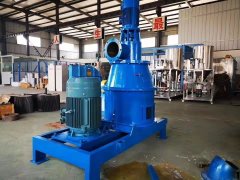
Chemical Material Polyethylene Wax Ultra-fine Mechanical Crusher Classified Impact Mill
Polyethylene wax is one of the most common chemical raw materials. During the solvent evaporation process, it can migrate to the surface of the coating film, ultimately forming a "waxed" surface layer together with other components of the coating. Hecai Chemical points out that it provides effective anti-oxidation and anti-corrosion effects. Therefore, it is also widely used in various industries, such as cosmetics, inks, rubber, and others.
In addition, it can also be used for deep processing of products in the following four categories:
1. Polyethylene used for hollow products:
High-density polyethylene has relatively high strength and is suitable for making hollow products, such as milk bottles and detergent bottles. It can be used to produce containers like bottles, barrels, tanks, and vats through blow molding, or to manufacture large containers such as tank truck tanks and storage tanks through casting.
2. Polyethylene used in pipes and sheets:
The extrusion method can produce polyethylene pipes, with high-density polyethylene pipes having higher strength, making them suitable for underground installation. Extruded sheets can undergo secondary processing. High-density polyethylene can also be made into low-foam plastics using foam extrusion and foam injection methods, serving as countertops and construction materials. Protective sheaths (e.g., cable sheaths).
3. Polyethylene used in fibers:
In China, it is called ethylene polymer, generally made from low-density polyethylene as the raw material, spun into synthetic fibers. Ethylene polymer is primarily used to produce fishing nets and ropes, or spun into short fibers for use as batting, and can also be used in industrial acid- and alkali-resistant fabrics.
Ultra-high molecular weight polyethylene fibers (with strength reaching 3–4 GPa) have now been developed and can be used as composite materials for bulletproof vests, cars, and offshore operations.
4. Polyethylene used for miscellaneous items:
Products manufactured through injection molding include daily necessities, artificial flowers, turnover boxes, small containers, parts for bicycles and tractors, etc.; refrigerator containers, storage containers, household kitchenware, sealing lids, etc.; high-density polyethylene is used for producing structural components.
1. **Process Principle**:
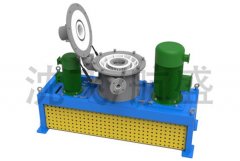
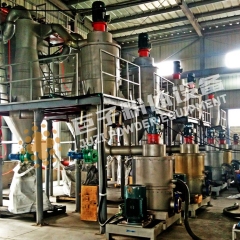
The raw material in the hopper is conveyed into the grinding chamber of the impact mill via a frequency-controlled feeding device for pulverization (the start/stop of the feeding device is controlled by the main motor current of the impact mill). The impact mill utilizes the hammers and toothed plates on a high-speed rotating rotor to impact the material being pulverized. Through intense collisions, friction, and shearing between the material and the rotor, the particles are ground into ultrafine powder. The pulverized material is then transported by an upward airflow to the classification zone, where a horizontally arranged classifying wheel screens out fine powder that meets the required particle size specifications.
® Ultra-fine Grinding, Precision Classification – Unbreakable, Meticulous (particle generation), and enters the rear collection device (dust collector) for collection and discharge; coarse particles that do not meet the particle size requirements are returned to the grinding zone for further grinding. This model utilizes fluid dynamics numerical simulation software developed in collaboration with the Institute of Aerodynamics to calculate the optimal flow field and ideal pressure distribution for design guidance, significantly improving grinding efficiency, reducing energy consumption, and minimizing over-grinding. The equipment has the following features:
2. Equipment Features:
1. Low energy consumption: Integrates centrifugal grinding, impact grinding, and extrusion grinding, saving up to 40–50% energy compared to other mechanical grinders.
2. High fineness: Equipped with a self-classifying grading system, with adjustable product fineness ranging from 5 to 50 μm.
3. Wide feed range: Feed particle size ≤3 mm, requiring only coarse crushing equipment for the material.
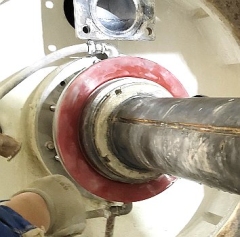
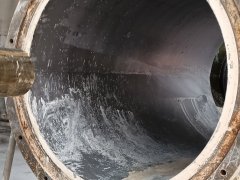
4. Low wear: Wear parts in the grinding section are made of new hard alloy wear-resistant materials, ensuring long service life.
5. Strong mechanical stability: Capable of continuous 24-hour operation without shutdown.
6. Full functionality:
- Can grind needle-like materials, achieving a finished product aspect ratio of 15:1.
- No temperature rise during grinding, suitable for grinding heat-sensitive materials.
- Can disperse sintered and agglomerated ultra-fine materials, with a particle size recovery rate of [placeholder].
- Features particle shaping functionality, effectively improving bulk density.
- Can grind fibrous materials.
- Can grind materials with high moisture content, with drying functionality.
- Can grind highly sticky materials.
7. Negative pressure operation, no dust pollution, excellent environmental conditions.
8. High degree of automation, strong stability, and easy operation.