- Products
-
Shops
AI Search
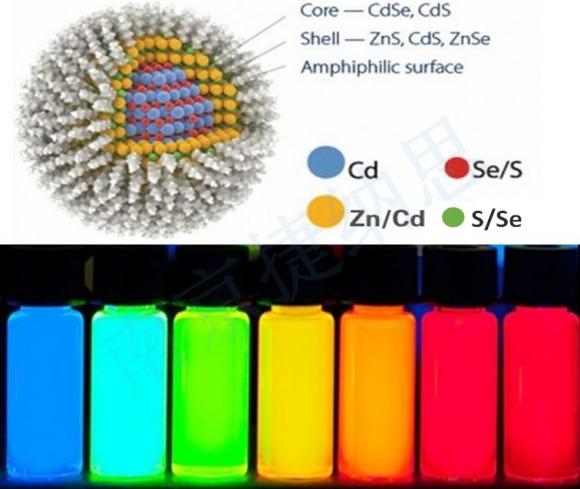
Quantum dots are nanoparticles with diameters ranging from 1 to 10 nm. When excited by external energy, these nanoparticles emit fluorescence corresponding to their own energy levels, making them a highly efficient luminescent material. Due to their small particle size, they possess superior and unique optical properties, as well as surface modifiability, and have become a rising star in the field of nanobiophotonics. They are widely used in the area of biological labeling. High-quality quantum dot solutions exhibit the following characteristics: a broad size range, narrow size distribution, good stability, and high fluorescence.
Quantum dots are nanoparticles with diameters ranging from 1 to 10 nm. When excited by external energy, these nanoparticles emit fluorescence corresponding to their own energy levels, making them a highly efficient luminescent material. Due to their small particle size, they possess superior and unique optical properties, as well as surface modifiability, and have become a rising star in the field of nanobiophotonics. They are widely used in the area of biological labeling. High-quality quantum dot solutions exhibit the following characteristics: a broad size range, narrow size distribution, good stability, and high fluorescence.
Product Features:
(1) Broad excitation wavelength range and narrow emission wavelength range allow the same excitation light to simultaneously excite multiple quantum dots, emitting fluorescence at different wavelengths. Compared to traditional fluorescent dye molecules, the excitation light wavelength range of fluorescent dyes is narrower, requiring multiple wavelengths of excitation light to excite various fluorescent dyes, which brings significant inconvenience in practical applications.
(2) The emission peaks are narrow and symmetrical with minimal overlap, whereas fluorescent dyes exhibit broad, asymmetrical emission peaks with severe tailing and significant overlap. This mutual interference poses challenging problems for analysis and detection.
(3) The emission wavelength can be tuned by controlling its size and composition, allowing the synthesis of quantum dots with any desired wavelength. The spectral peaks of uniformly sized quantum dots exhibit a symmetric Gaussian distribution.
(4) The fluorescence intensity and stability are approximately 100 times greater than those of ordinary fluorescent dyes, allowing for long-term observation of the labeled objects.
(5) Quantum dots, after various chemical modifications, exhibit good biocompatibility, enabling specific binding with minimal harm to organisms. They can be used for in vivo biological labeling and detection. In contrast, fluorescent dyes are generally more toxic and have poor biocompatibility.
PS: High quantum yield QDs are custom-made products because their quantum yield is higher than that of ordinary quantum dots, so special instructions are required when purchasing.
Water-soluble CdTe quantum dots
Oil-soluble CdTe quantum dots
Oil-soluble CdSe quantum dots
Oil-soluble CdSe/ZnS quantum dots