- Products
-
Shops
AI Search

Working principle:
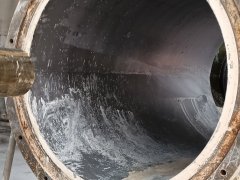
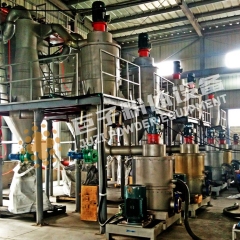
The material is transported by the feeding device to the main crushing chamber, where it undergoes crushing through mutual impact, collision, friction, shearing, and extrusion between the material, high-speed rotating components, and particles. The crushed material is separated into coarse and fine powders by a classifying wheel, with the coarse powder flowing back into the crushing chamber for further grinding, while the purified gas is discharged by an induced draft fan.
Equipment Features:
1. Low energy consumption: It integrates centrifugal crushing, impact crushing, and extrusion crushing, achieving energy savings of up to 40–50% compared to other types of mechanical crushers.
2. High fineness: Equipped with a self-classifying grading system, product fineness ≥2500 mesh.
3. Wide feeding range: The feeding particle size is ≤50mm, and the material only needs to undergo one stage of coarse crushing.
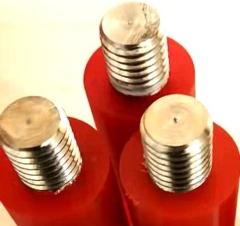
4. Low Wear: The wear-prone components in the crushing section are made of composite wear-resistant new materials, offering a long service life and no contamination when processing materials with a Mohs hardness of ≤5.
5. Strong mechanical stability: Capable of 24-hour continuous production without downtime.
6. Full functionality:
Capable of crushing needle-like materials, achieving a finished product aspect ratio of 15:1.
The crushing process involves no temperature rise, making it suitable for crushing heat-sensitive materials.
It can perform dispersion operations on sintered agglomerated ultrafine materials, achieving a 100% particle size recovery rate.
With particle shaping functionality, it effectively increases the packing density.
Material capable of crushing fibrous tissue;
It can crush materials with high moisture content and has a drying function.
Can crush materials with strong stickiness.
7. Negative pressure production ensures no dust pollution and an excellent working environment.
8. High degree of automation, strong stability, and easy operation.
9. The entire system adopts automated control, enabling one-key start/stop, making operation simple and convenient. When connected to the central control, remote control can be achieved.
Scope of Application:
1. Typical non-metallic mineral materials include: ultra-fine grinding of hard kaolin, talc, graphite, calcite, gypsum, diatomite, wollastonite, barite, pyrophyllite, aluminum hydroxide, and other materials, as well as ultra-fine grinding and dispersion of nano-calcium carbonate, cerium oxide, and similar substances.
2. Typical heat-sensitive materials include: lactose, wax, resin, fat, bone meal, plants, etc.
3. Typical materials for ultrafine processing of Chinese herbal medicines and raw materials include: pollen, hawthorn, shiitake mushrooms, pearl powder, stomach medicine, nimodipine, antibiotic drugs, lingzhi (reishi mushroom), Chinese gall, fleeceflower root, andrographis, mint, houttuynia, fern root, kudzu root, isatis root, and others.
Main Technical ParametersMain technical parameters
| Device Model Model | Feed particle sizeMax feed Size | Product finenessProduct Size | Production capacityCapacity | Installed powerPower |
ZJ-C100 | <3 mm | 1-75µm | 3-15kg/h | 12 kw |
ZJ-C200 | <3 mm | 1-75µm | 20-100 kg/h | 25kw |
ZJ-C400 | <3 mm | 1-75µm | 60-400 kg/h | 65kw |
ZJ-C600 | <3 mm | 1-75µm | 100-1000 kg/h | 100kw |
ZJ-C1000 | <3 mm | 1-75µm | 400-2000 kg/h | 160kw |
ZJ-C1250 | <3 mm | 1-75µm | 600-4000 kg/h | 200kw |
Application Cases