- Products
-
Shops
AI Search

Equipment Consultation Hotline: 13035695787 (Same as WeChat ID)
Ferrous sulfate is an inorganic compound with the molecular formula FeSO4. It is a pale yellow solid with strong acidity and is highly corrosive. It is typically soluble in water, and when the solution contains chloride ions, it forms a brownish precipitate, also known as iron sulfate rust.
The main functions of ferrous sulfate are as follows:
1. Ferrous sulfate can be used as a water treatment agent to remove impurities from water while inhibiting bacterial growth.
2. Ferrous sulfate can be used as a disinfectant to kill bacteria and viruses in water.
3. Ferrous sulfate can be used as a reducing agent to reduce complex organic molecules, making them easier to decompose.
4. Ferrous sulfate can be used as a catalyst to accelerate complex reactions, thereby saving time and energy.
5. Ferrous sulfate can be used as a mineral solvent to extract minerals, such as metal ions, as well as other important organic substances.
6. Ferrous sulfate can be used as a dye to impart dark colors to textiles and other items, thereby giving them a beautiful appearance.
7. Ferrous sulfate can be used as an antimicrobial agent to inhibit the growth of mold, bacteria, and fungi.
8. Ferrous sulfate can be used as a cement additive to improve the performance of cement, enhancing its water resistance and wear resistance.
9. Ferrous sulfate can be used as a wastewater treatment agent, effectively removing organic substances and heavy metal ions from sewage.
10. Ferrous sulfate can be used as a plant care agent, effectively preventing harm from plant pests.
Characteristics of Production Equipment for Crushing and Classifying Ferrous Sulfate Powder
1. Process Principle:
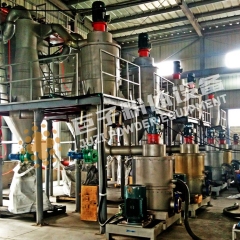
The raw materials in the silo are transported to the grinding chamber of the impact mill for crushing via a feeding device (the start and stop of the feeding device are controlled by the main motor current of the impact mill). The impact mill uses hammers and toothed plates on a high-speed rotating rotor to impact the material being crushed, leveraging the interaction between the material and the rotor.Intense collision, friction, and shearing occur to achieve ultra-fine crushing of particles.The crushed material is transported by an upward airflow to the classification zone, where a horizontally arranged classifier wheel screens out fine powder that meets the particle size requirements (without generating large particles). This fine powder then enters the downstream collection device (dust collector) for collection and discharge. Coarse powder that does not meet the particle size requirements is returned to the crushing zone for further crushing.
This model utilizes a computational fluid dynamics simulation software developed by the Aerodynamics Research Institute to calculate the *optimal flow field and *ideal pressure distribution to guide the design, significantly improving crushing efficiency, reducing energy consumption, and minimizing over-crushing. The equipment features the following characteristics:
2. Equipment Features:
Ø Low energy consumption: Integrates centrifugal crushing, impact crushing, and extrusion crushing, achieving energy savings of up to40~50%。
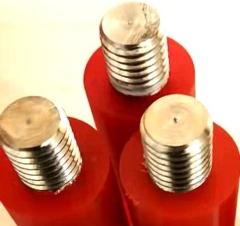
Ø Low wear: The wearing parts in the crushing section are made of composite wear-resistant new materials, ensuring a long service life.
Ø Strong mechanical stability: suitable for long-term use24-hour non-stop production.
Ø Full-featured:
² It can crush needle-like materials to achieve a finished product with a specific aspect ratio.15:1;
² During the crushing process, the temperature rise can be controlled (optional air cooler), making it suitable for crushing heat-sensitive materials.
² It can perform dispersion operations on sintered and agglomerated ultrafine materials, with a particle size recovery rate of100%;
² With particle shaping functionality, effectively increasing bulk density.
² Material capable of crushing fibrous tissue;
² Can crush materials with strong stickiness.
Ø Negative pressure production, no dust pollution, excellent environment.
Ø High degree of automation, strong stability, and easy operation.