- Products
-
Shops
AI Search

Scope of Application
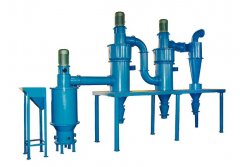
HS Air Jet Mill is a device that utilizes high-speed airflow to achieve ultra-fine dry grinding of materials. It consists of a grinding chamber, a cut-off classifier, a feeding device, an air source system, and a collection system. Materials enter the grinding chamber through the feeding device, where compressed air is injected at high speed through specially designed nozzles. The materials accelerate in the high-speed jet stream and undergo repeated impacts and collisions at the intersection of the nozzles, achieving grinding. The ground materials rise with the airflow into the classification chamber. Due to the high-speed rotation of the cut-off classifier, particles experience both centrifugal force generated by the classifier rotor and centripetal force caused by the viscous effect of the airflow. When the centrifugal force on a particle exceeds the centripetal force, coarse particles above the classification diameter return to the grinding chamber for further impact grinding. Fine particles below the classification diameter are carried by the airflow into a cyclone separator and collected by a collector, while the gas is discharged by an induced draft fan.
Technical Features
The classification impeller adopts a vertical large impeller, featuring low rotational speed and stable operation. The flow field in the classification zone is stable, ensuring consistent product particle size without large particles. Compared with other types of classifiers, it offers higher cut-point precision and classification efficiency.
System power is optimized and configured with low power consumption and low energy consumption per unit.
The system operates under full negative pressure in a sealed environment, preventing any dust leakage and ensuring an excellent production environment. The entire system is highly automated, with a high degree of control and simple operation.
Flowchart:
1. Feeding System 2. Jet Mill 3. Cyclone Collector 4. Pulse Dust Collector 5. Induced Draft Fan 6. Electrical Control Cabinet
Institutional schematic diagram:
1. Motor 2. Motor base 3. Classification upper end 4. Classification impeller 5. Classification chamber 6. Feed inlet 7. Air reservoir 8. Nozzle
9. Crushing Chamber 10. Secondary Air Inlet 11. Discharge Outlet
Technical Parameters: