- Products
-
Shops
AI Search

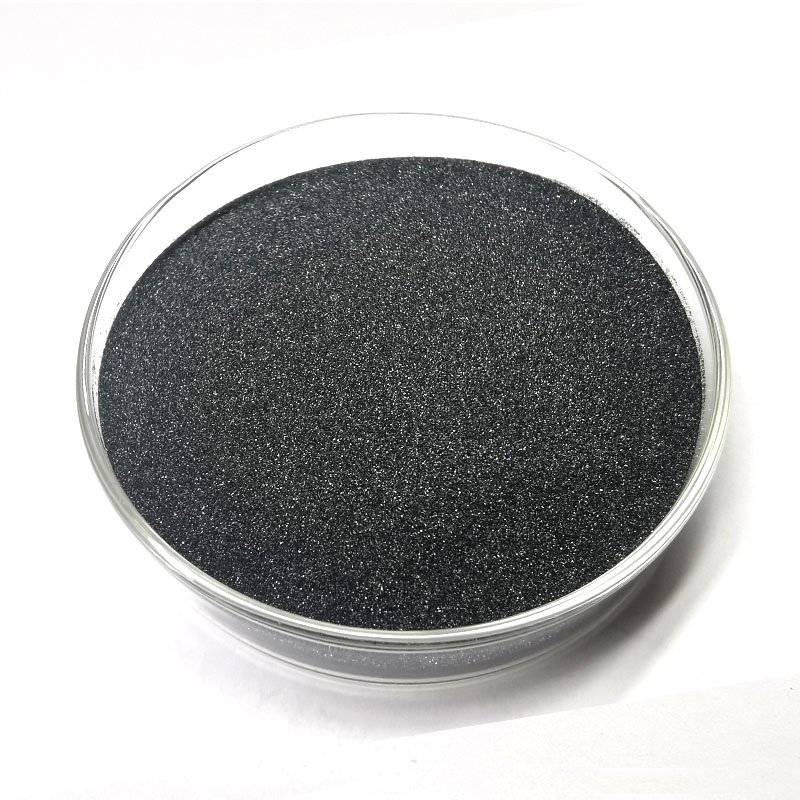
Silicon carbide abrasive grit 80 mesh 120 mesh
Abrasive-grade silicon carbide is a synthetic abrasive material produced by smelting carbonaceous materials and siliceous materials at high temperatures in large resistance furnaces. The carbonaceous materials include petroleum coke or coal coke, while the siliceous materials primarily consist of quartz sand. Additionally, additives such as sawdust and salt are introduced during the smelting process.
The silicon carbide purity of first-grade black silicon carbide is above 98%, with a shiny appearance that reflects a rainbow of colors. Generally, the higher the purity of silicon carbide, the better its physical and chemical properties. Black silicon carbide has a slightly lower hardness than green silicon carbide, with a Mohs hardness of 9.2-9.3, which is higher than that of corundum abrasives.
Haixu Black Silicon Carbide Grit is produced from first-grade silicon carbide block material through processes such as crushing, washing, screening, and magnetic separation. It features high purity, high cleanliness, high bulk density, and low impurity content, fundamentally distinguishing it from silicon carbide made from recycled materials on the market.
Characteristics of Silicon Carbide Abrasive Grit: 80 Mesh and 120 Mesh
1. Superior oxidation resistance and chemical stability: When heated to 1000°C in air, silicon carbide only oxidizes on the surface, forming a layer of silicon dioxide film that protects the silicon carbide material from oxidation. Only when heated above 1627°C does the oxidation resistance of silicon carbide rapidly decline.
2. High Hardness: Black silicon carbide has a Mohs hardness of 9.2-9.3, while green silicon carbide has a Mohs hardness of 9.4-9.5, with a Vickers hardness of 3100-3400 kg/mm². The hardness of silicon carbide decreases as temperature increases. At a high temperature of 1200°C, the hardness of silicon carbide can reach twice that of corundum.
3. High Toughness: The toughness of silicon carbide abrasive refers to the difficulty of breaking under external force. Taking 46 mesh as an example, the toughness tested by the static pressure method is approximately 68-78%. The mechanical strength of silicon carbide is higher than that of corundum. For instance, at 120 mesh particle size, the compressive strength of silicon carbide is 186 KN/cm², while that of corundum abrasive is 100 KN/cm².
4. Low thermal expansion coefficient: At temperatures ranging from 25 to 1400 degrees Celsius, the average thermal expansion coefficient of silicon carbide is 4.4x10⁻⁶/℃, while that of corundum is 7-8x10⁻⁶/℃.
Chemical composition of silicon carbide abrasive grits in 80 mesh and 120 mesh:
SiC | ≥98% |
SiO2 | ≤1% |
H2O3 | ≤0.5% |
Fe2O3 | ≤0.3% |
F.C | ≤0.3% |
Magnetic substance | ≤0.02% |
Physical indicators of silicon carbide abrasive grits in 80 mesh and 120 mesh:
Mohs hardness | 9.2 |
Melting point | 2300 ℃ free |
Operating temperature | 1900℃ |
Specific gravity | 3.2-3.45 g/cm3 |
Bulk density | 1.2-1.6 g/cm3 |
Color | Black |
Crystal form | Hexagonal crystal system |
Elastic modulus | 58-65x106 psi |
Coefficient of Thermal Expansion | 3.9-4.5 x10⁻⁶/ ℃ |
Thermal conductivity | 71-130 W/MK |
Uses of 80-mesh and 120-mesh Silicon Carbide Abrasive Grains:
Stone sandblasting, stone carving
Surface cleaning of stainless steel semiconductor components.
Ceramic products, electronic ceramic sandblasting and grinding.
Polishing stone, polishing marble, etc.
Jade and gemstone grinding and polishing.
Gemstone polishing, gemstone drilling.
Polishing and grinding of glass art pieces, etc.
Common specifications for silicon carbide abrasive grit:
Black Silicon Carbide F Sand: 12#, 16#, 20#, 24#, 30#, 36#, 40#, 50#, 60#, 80#, 100#, 120#, 150#, 180#, 220#
Black Silicon Carbide F-grade Micro Powder (European Standard): 230#, 240#, 280#, 320#, 360#, 400#, 500#, 600#, 800#, 1000#, 1200#
Black Silicon Carbide W Standard Micro Powder (W Standard): W63, W50, W40, W28, W20, W14, W10, W7, W5, W3.5
Black Silicon Carbide JIS Standard Micro Powder (Japanese Standard): 240#, 280#, 320#, 360#, 400#, 500#, 600#, 800#, 1000#, 1200#, 1500#, 2000#, 2500#, 3000#, 4000#
|
Granule Degree | *Coarse-grained | coarse grain | Elementary particles | Mixed particles | fine-grained | |||
100%Through the following sieve numbers | Not passing the sieve number. | Weight % Not more than | Not passing the sieve number. | Weight % At least | Not passed Screening | Weight % No less than | *Up to 3% more by weight through the following sieve numbers* | |
100 | 6 | 8 | 20 | 10 | 45 | 10 12 | 70 | 14 |
12# | 7 | 10 | 20 | 12 | 45 | 12 14 | 70 | 16 |
14# | 8 | 12 | 20 | 14 | 45 | 14 16 | 70 | 18 |
16# | 10 | 14 | 20 | 16 | 45 | 16 18 | 70 | 20 |
20# | 12 | 16 | 20 | 18 | 45 | 18 20 | 70 | 25 |
22# | 14 | 18 | 20 | 20 | 45 | 20 25 | 65 | 30 |
24# | 16 | 20 | 25 | 25 | 45 | 25 30 | 65 | 35 |
30# | 18 | 25 | 25 | 30 | 45 | 30 35 | 65 | 40 |
36# | 20 | 30 | 25 | 35 | 45 | 35 40 | 65 | 45 |
40# | 25 | 35 | 30 | 40 | 40 | 40 45 | 65 | 50 |
46# | 30 | 40 | 30 | 45 | 40 | 45 50 | 65 | 60 |
54# | 35 | 45 | 30 | 50 | 40 | td width="13" nowrap valign="top" style="border-top: none; border-left: none; border-bottom-width:
|||