- Products
-
Shops
AI Search

1. Material Drying Requirements:
Drying of fuel rods
Material Parameters:
Name: Fuel Stick (Cow Dung and Sawdust Mixture)
Size: Diameter 40mm, Length 100mm
Unit weight: ≈150g
Moisture content before drying: 40%
Moisture content after drying: 15%
Output: 10000kg/h
II. Selection of Drying Equipment and Main Technical Parameters:
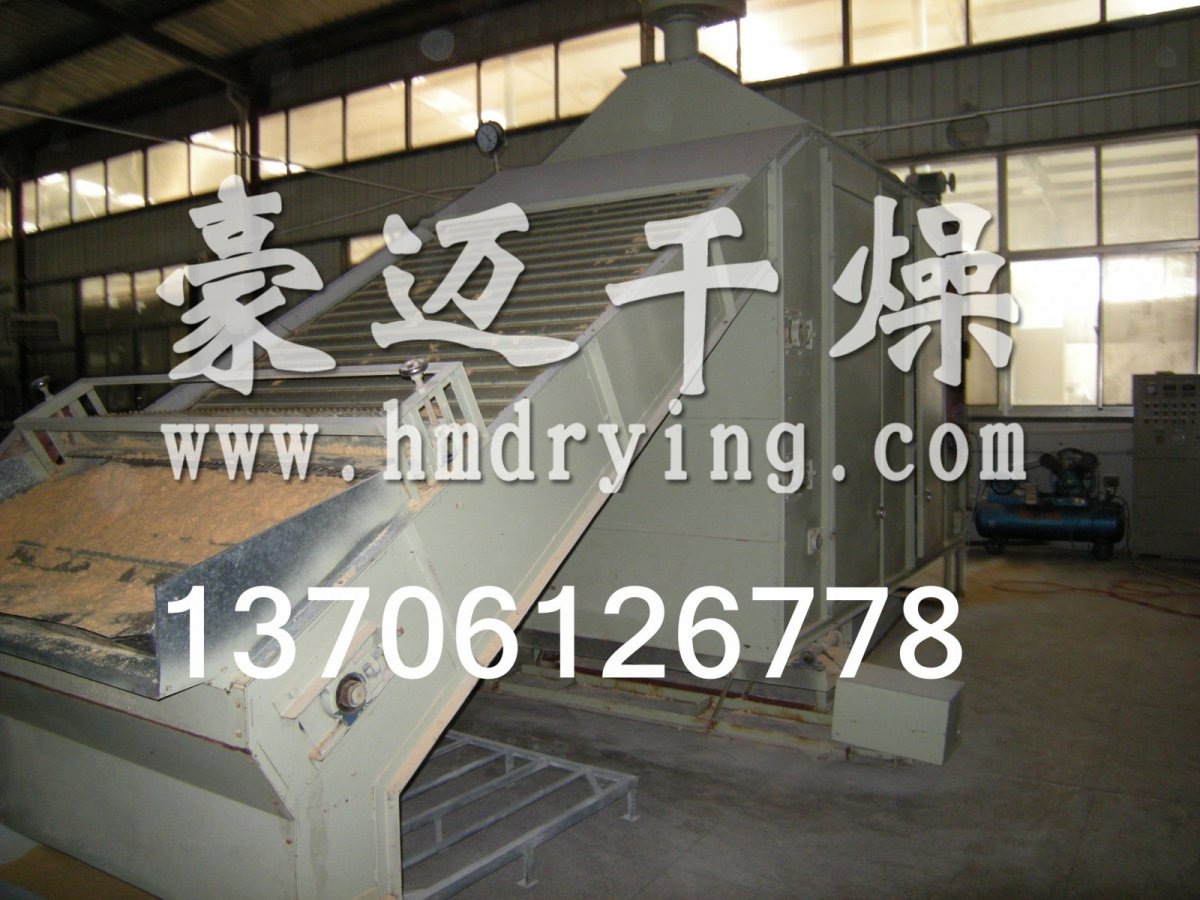
DW - Through-flow Belt Dryer (Heated by Direct-fired Hot Air Stove)
Dryer main unit width: 3000mm, drying section length: 34000mm
Equipment footprint (length × width × height): 34000 × 3000 × 2520
Installed power: 56.5 kW/h
Circulating fan 4-72-6C-2.2kw, 15 units
Dehumidifying fan 4-72-6C-2.2kw, 3 units
Speed-regulating motor BWDE-185-5.5kw 1 unit
III. Equipment Selection:
Due to the need for continuous production and to ensure product integrity, materials must remain stationary during the production process to minimize unnecessary disturbances. For this purpose, a single-layer DW series belt dryer can be selected. If production space is limited, a multi-layer DW belt dryer can also be used to reduce the equipment's footprint.
IV. Design Description:
The DW series belt dryer is a ** single-layer cross-flow belt series product introduced in 1991, which has been successfully applied to the drying of various materials such as dehydrated vegetables, traditional Chinese medicine slices, roasted snacks, shrimp crackers, washed wool, ceramic powder, and ores. The working principle of the equipment is shown in Figure 1. The dryer is divided into several units, each with independently adjustable hot air temperature. The hot air circulation method can be upward ventilation, downward ventilation, or a combined ventilation method. Typically, a combined ventilation method integrating upward and downward airflow is adopted. Due to significant differences in the drying characteristics of various materials, the equipment selection must be determined through consultation with design personnel to achieve a more reasonable ventilation combination and drying temperature curve. The exhaust gas emission of this type of equipment involves extracting a certain amount of exhaust gas from each unit, which is discharged by a dedicated moisture removal fan. The extraction volume of each unit is controlled by a regulating valve to facilitate the control of the drying atmosphere inside the equipment. Combined with temperature control for each unit, feed rate control, and mesh belt speed adjustment, the ** optimal performance can be achieved. The designed exhaust gas emission of this equipment accounts for 10%-17% of the total gas circulation volume. When the characteristics of the materials differ, the equipment selection varies significantly. The performance and specifications of the DW series are detailed in the attached table.
5.Theoretical Calculation:
1. Calculation of Water Evaporation Amount
Assume: The dry feed amount is G1, and the moisture content of the wet material is X1.
Product quantity is G2, product moisture content is X2
The amount of evaporated water is W.
Based on the principle that **the amount of dry material remains unchanged before and after drying**, then:
(1-X1)G1=(1-X2)G2 ①
W= G 1-G2 ②
1-X2
From ①, let G1 = ————— G2 ③
1-X1
1-X2 X1-X2
③ Substitute into ② W = ——— G² − G² = ——— G² ④
1-X1 1-X1
Given X1 = 40% (moisture content of wet material) X2 = 15%
G2=10000㎏/h
1-15%
Substitute ① G1 = ————— ×10000=14167/h
1-40%
W = 14167 kg/h (feed rate) – 10000 kg/h (product rate) = 4167 kg/h
VI. Process Flowchart or Images(Figure 1)
1. Feeder 2. Conveyor belt 3. Heater 4. Air distributor 5. Moisture exhaust fan 6. Control valve 7. Circulation fan
VII. User Units Related to Equipment
Sichuan Pangang Group Co., Ltd. Pilot Line Project
Hebei Xingtai Huakai Industrial Co., Ltd. Environmental Clean Coal Project