- Products
-
Shops
AI Search

China's sludge treatment development started relatively late, with the following main issues: outdated technical facilities for sludge treatment; low investment in sludge treatment and disposal; low design and management standards for sludge treatment, and complex sludge treatment conditions. Overall, the level of sludge treatment is low, and there is a lack of specialized planning. Wastewater treatment plants in China primarily use traditional treatment methods, which involve high investment and energy consumption. The main challenges encountered include: a large number of microorganisms in the sludge, making mechanical dewatering difficult; and the organic matter in the sludge being solid, which also makes biodegradation challenging.
Many chemical enterprises' wastewater treatment plants transport sludge from belt filter presses to external sites for dumping, polluting the surrounding environment. The state has now explicitly prohibited the external dumping of sludge, so enterprises must dry the sludge themselves before incineration or supplying it to building materials factories for brick production. As a result, sludge drying will become a highly promising engineering project in the future. The hollow paddle dryer developed by our company is particularly suitable for sludge drying and has been widely applied in numerous enterprises both domestically and internationally, achieving excellent treatment results.
Sludge Drying and Dewatering EquipmentHere is the English translation of "简介": **Introduction**
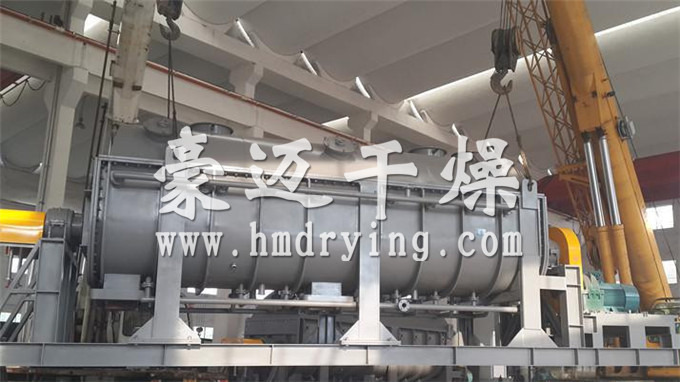
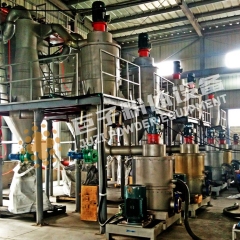
A sludge dryer is a device that utilizes the heat conduction principle of wedge-shaped hollow paddles and the inner wall of a cylindrical device to indirectly heat sludge generated from industrial wastewater, as well as sludge in a paste-like or slurry-like state. This process enables the dewatering and drying of printing and dyeing sludge, domestic sludge, or sludge produced from domestic wastewater treatment, reducing its volume. The dried sludge can then be comprehensively utilized, turning waste into valuable resources and avoiding secondary pollution. It is currently the most ideal drying equipment for sludge treatment.
Sludge Drying and Dewatering EquipmentWorking Principle:
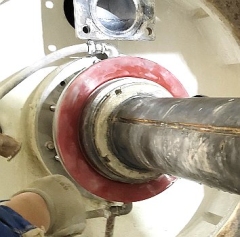
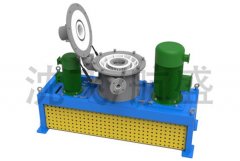
The sludge dryer for domestic wastewater treatment employs a special wedge-shaped stirring heat transfer paddle, offering high heat transfer efficiency and a self-cleaning function for the heat transfer surface. Its structure features densely arranged wedge-shaped hollow paddles on a hollow shaft, providing a large heat transfer area per unit effective volume. The heat medium can be steam, thermal oil, or other carriers, with an operating temperature range of 18–230°C. Since domestic sewage sludge or printing and dyeing wastewater sludge is in a paste or slurry form, the sludge dryer is designed with wedge-shaped paddle heat transfer surfaces. The continuous relative motion between the paste or slurry and the wedge-shaped paddle surfaces generates a scouring effect, ensuring that the wedge-shaped heat transfer surfaces of the equipment maintain excellent self-cleaning properties, regardless of whether the sludge is in granular, powder, paste, or slurry form. In addition to the wedge-shaped hollow paddle drive shaft, the dryer's outer shell features a circular bottom and a rectangular top, with 2–4 hollow stirring shafts arranged inside. Sealed end covers are installed between the shafts and the shell. The upper cover prevents material dust from escaping while also collecting wet steam. To ensure effective drying, a material level baffle is installed at the discharge outlet to maintain the material height, ensuring that the heat transfer surfaces are covered by the material and fully utilize heat conduction. The heat medium (steam or thermal oil) of the dryer enters the densely distributed hollow paddles on the shaft through a rotary joint at the shaft end, while the shell jacket and hollow shaft simultaneously heat the material.
While steam is introduced into the blades and jacket for heating, preheated dry air is simultaneously supplied to the upper part of the discharge port for further drying, significantly enhancing the drying capacity of the equipment. The evaporated moisture is carried out of the dryer by the exhaust gas, passes through a bag filter to recover the dried fine powder, and the humid air is discharged outdoors by an induced draft fan after water dust removal.
Sludge Drying and Dewatering EquipmentFeatures:
1. Low energy consumption of the paddle dryer: Due to indirect heating, there is no large amount of carried air to take away heat, and the outer wall of the dryer is equipped with an insulation layer. For slurry materials, evaporating 1 kg of water requires only 1.2 kg of steam.
2. Low cost of the paddle dryer system: It has a huge heat transfer surface per unit effective volume, which shortens processing time and reduces equipment size. This significantly decreases the building area and space required.
3. Wide range of material processing: By using different media, it can handle both heat-sensitive materials and those requiring high-temperature treatment. Common media include steam, thermal oil, hot water, and cooling water. It can operate continuously or intermittently and is applicable in many fields.
4. Minimal Environmental Pollution: It carries very little air and entrains minimal dust and materials. For processes involving polluting materials or the need to recover solvents, a closed-loop circulation can be adopted.
5. Low Operating Costs: The equipment requires only one person per day for normal operation. With low-speed stirring and a reasonable structure, wear and tear is minimal, resulting in very low maintenance costs.
6. Stable Operation: Due to the unique compression-expansion stirring action of the wedge-shaped blades, the material particles come into contact with the heat transfer surface. Within the axial zone, the temperature, humidity, and mixing temperature gradient of the material are very small, thereby ensuring process stability.
7. Sufficient heating time can effectively eliminate viruses, bacteria, and other pathogens, meeting the requirements of environmental standards.
8. The solid content of the dried sludge is high (**can reach over 90%**).
Technical Parameters of Sludge Dryer (Case Study):
1. Before drying, the moisture content of the sludge is above 80-86%.
2. The moisture content after drying is approximately 10-15%.
3. Volume Change: The volume decreases by 4 to 5 times after drying.
4. Output: 10-20 tons/day of sludge with a moisture content above 80%. After drying, each ton of sludge can produce approximately 0.13 tons of powdered and partially 5mm small granular dried sludge powder.
5. The lower calorific value of dried sludge powder is approximately 1,300 to 1,500 kcal.
6. Steam consumption.
7. Power consumption: 15 kW/h
8. Main machine specifications: 6500×2000×1800 (length × width × height)
Changzhou Haomai Drying Engineering Co., Ltd. values talent and technological innovation, continuously developing sludge dryers that are efficient, easy to operate, and equipped with advanced controls, striving to provide customers with mature technology and satisfactory products. To make the design solutions more practical, the company also maintains a variety of test prototypes for customers to conduct material testing and obtain reliable data.
Contact Number: 13906112721 Manager Zhang