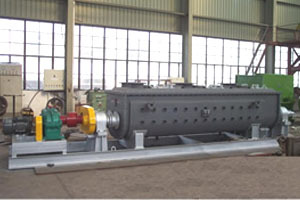
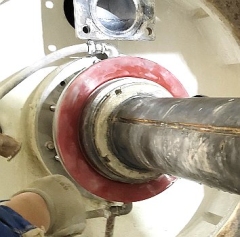
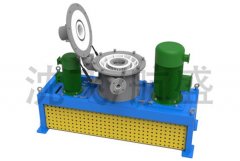
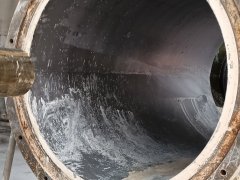
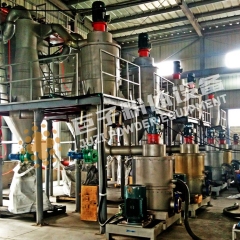
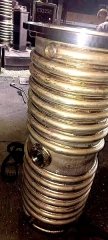
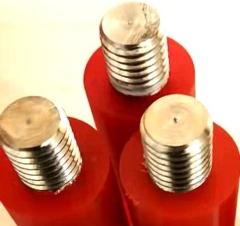
Application: The paddle dryer has been successfully applied in fields such as food, chemical, petrochemical, dye, and industrial sludge. Its heat transfer, cooling, and stirring characteristics enable it to perform the following unit operations: calcination (low temperature), cooling, drying (solvent recovery), heating (melting), reaction, and sterilization. The stirring paddles also serve as heat transfer surfaces, increasing the heat transfer area per unit effective volume and shortening processing time. The wedge-shaped paddle heat transfer surfaces also possess self-cleaning functionality. The compression-expansion stirring action ensures uniform mixing of materials. The material moves in a "plug flow" pattern along the axial direction, with minimal gradients in temperature, humidity, and mixing degree within the axial zone. ● Using thermal oil as the heat medium, the paddle dryer can perform low-temperature calcination. For example: calcium sulfate dihydrate (Ca2SO4·2H2O) is calcined and converted into calcium sulfate hemihydrate (Ca2SO4·1/2H2O). Sodium bicarbonate (NaHCO3) is calcined and converted into soda ash (Na2CO3), etc. ● By introducing a cooling medium, such as water or chilled brine, it can be used for cooling. For example, in the soda ash industry, the paddle-type soda ash cooler replaces the outdated air-cooled soda ash cooler, saving energy and exhaust gas treatment equipment, reducing operating costs. It can also be used for cooling titanium dioxide, nickel-iron alloy powder, and various granular materials. In a single machine, the material can be cooled from 1000°C to below 40°C. ● The primary function of the drying equipment is to achieve an ideal state for solvent recovery, energy consumption, and environmental control without using hot air. It is particularly suitable for materials that require solvent recovery, are flammable, easily oxidized, or heat-sensitive. It has been widely used in the fine chemical, petrochemical, and dye industries. ● Within the axial range, the uniformity of temperature, humidity, and mixing degree allows the equipment to be used for heating or melting, or for conducting reactions with solid materials. It has been successfully applied in the compound fertilizer and modified starch industries. The paddle dryer can be used for sterilizing food and flour. The large heating area per unit effective volume quickly heats the material to the sterilization temperature, avoiding prolonged heating that could alter the material's quality. Features: ● Low energy consumption of the paddle dryer: Due to indirect heating, there is no large amount of entrained air carrying away heat, and the outer wall of the dryer is equipped with an insulation layer. For slurry materials, evaporating 1 kg of water requires only 1.22 kg of steam. ● Low cost of the paddle dryer system: It has a huge heat transfer surface per unit effective volume, which shortens processing time and reduces equipment size. This significantly decreases the building area and space required. ● Wide range of material processing: By using different heat transfer media, it can handle both heat-sensitive materials and those requiring high-temperature treatment. Common media include steam, thermal oil, hot water, and cooling water. It can operate continuously or intermittently, making it applicable in many fields. ● Low Environmental Pollution: No carrier air is used, resulting in minimal dust entrainment. The evaporation of material solvents is very low, making treatment easier. For materials that cause pollution or require solvent recovery, a closed-loop circulation system can be adopted. ● Low operating cost: The equipment requires only 1-2 people per day for normal operation. With low-speed stirring and a reasonable structure, wear is minimal, and maintenance costs are very low. ● Stable Operation: Due to the special compression-expansion mixing action of the wedge-shaped blades, the material particles are fully in contact with the heat transfer surface. Within the axial zone, the gradients of temperature, humidity, and mixing degree of the material are very small, thereby ensuring process stability.
Friendly reminder: Due to differences in purchase situations and consultation times for each inquirer, the following response is provided for reference only.3Valid within days, for reference only by other netizens.。
Product Inquiry分页占位
发布询price咨询
Consultation Type:
Consultation Content:
Changzhou Haomai Drying Engineering Co., Ltd.
Contact人:Manager Deng
Phone:18519933863
WeChat:18519933863
Email:
Address:Changzhou Wujin District Jiaoxi Town Sanhekou Industrial Park
Please let us know if you are inquiring about...「New Material Help」I saw it online; it helps facilitate the transaction.。