- Products
-
Shops
AI Search

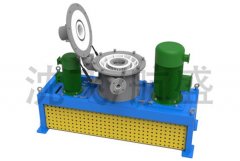
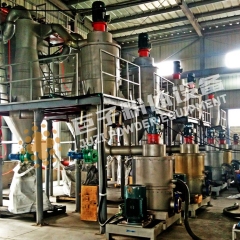
The flash dryer operates as hot air enters tangentially at the bottom of the drying chamber, forming a powerful rotating airflow driven by an agitator. Material is fed into the dryer via a screw feeder, where it is dispersed under the intense action of a high-speed rotating stirring paddle. Through impacts, friction, and shear forces, the material is broken down, with lumpy materials rapidly crushed, allowing full contact with the hot air for heating and drying. The dried material is carried by the airflow into a dust collection system for recovery and treatment. The exhaust gas, meeting environmental requirements with a dust concentration of ≤50 mg/m³, is discharged into the atmosphere by an induced draft fan, completing the entire drying process.
Advantages of the equipment
1. The high circumferential air velocity inside the drying chamber and the short material residence time effectively prevent material adhesion to the walls and deterioration of heat-sensitive materials, while enabling the production of uniform powdered products in a single drying process, eliminating the need for crushing, sieving, and other steps.
2. The drying chamber is equipped with classification rings and swirl blades, allowing for adjustable material fineness and final moisture content. A special air distribution device reduces equipment resistance and effectively improves the uniformity of material drying.
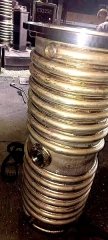
A special cooling device and pneumatic sealing mechanism are installed at the bottom of the dryer to prevent material deterioration in the high-temperature zone at the bottom.
4. It can effectively control the final moisture content and fineness. By adjusting the feeding rate, hot air temperature, and classifier, the moisture content and fineness of the product are ensured to be uniform and consistent.
Applicable Materials
Paste-like, slurry-like, filter cake, and other materials, as well as materials dewatered by plate-and-frame filter presses or centrifuges. For example:
1. Inorganic categories: boric acid, calcium carbonate, hydroxides, copper sulfate, iron oxide, barium carbonate, antimony trioxide, various metal hydroxides, various heavy metal salts, synthetic cryolite, etc.;
2 Organic compounds: Atrazine (pesticide insecticide), cadmium laurate, benzoic acid, benzoin, captan, sodium oxalate, cellulose acetate, etc.;
3 Ceramics: kaolin, silicon trioxide, clay, etc.;
4. Dye categories: anthraquinone, black iron oxide, indigo pigment, butyric acid, titanium hydroxide, zinc sulfide, various azo dye intermediates.
5. Food category: soy protein, gelatinized starch, distiller's grains, wheat sugar, wheat starch, etc.
Technical Specifications
Model | XSG-2 | XSG-4 | XSG-6 | XSG-8 | XSG-10 | XSG-12 | XSG-16 | XSG-20 |
Inner diameter of the main unit (mm) | 200 | 400 | 600 | 800 | 1000 | 1200 | 1600 | 2000 |
Airflow M3/h | 350-500 | 1150-2000 | 2450-4500 | 4450-7550 | 7000-12500 | 10000-20000 | 18000~36000 | 28200-56500 |
Evaporated water content (kg/h) | 12-17 | 40-70 | 80-150 | 150-250 | 230-4250 | 300-600 | 600-1000 | 1000-1500 |
**Installed Capacity (kW)** | 10 | 20 | 40 | 65 | 85 | 105 | 150 | 230 |
**Height m | 4.0 | 4.8 | 5.8 | 6.5 | 7.1 | 7.8 | 8.8 | 10.1 |
Floor area (m²) | 15 | 20 | 28 | 35 | 40 | 52 | 80 | 150 |
Note: 1. The water evaporation amount is based on the water evaporated per hour when the inlet air temperature is 180°C and the outlet air temperature is 80°C.
2. In addition to the above models, special designs can be made for users.
3. The above installed capacity is based on standard configuration; the power configuration can be significantly reduced depending on the material.