- Products
-
Shops
AI Search

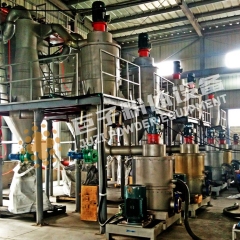
High-capacity ammonium thiocyanate dryer, advanced sodium thiocyanate rotary drum drying equipment, Changzhou specialized drying equipment for ammonium thiocyanate.
Introduction to Ammonium Thiocyanate Dryer
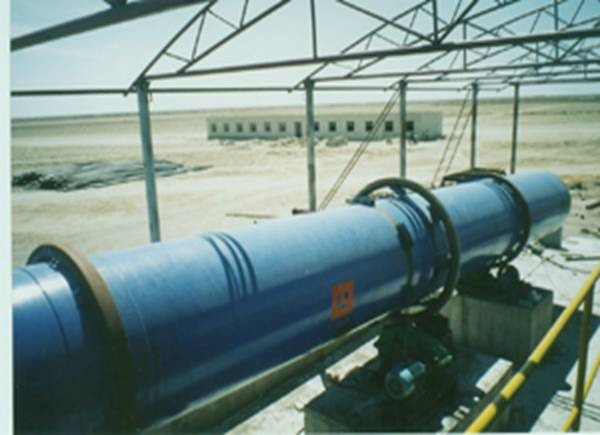
A drum dryer (also known as a rotary drum dryer, revolving dryer, etc.) is a contact-type internal heating conduction drying machine. During the drying process, heat is transferred from the inner wall of the drum to its outer wall, passing through the food material attached to the outer wall surface to evaporate the moisture from the material. It is a continuous drying production machine.
Working Principle of Advanced Sodium Thiocyanate Rotary Drum Drying Equipment
The drum of the drum dryer is a slightly inclined and rotatable cylindrical body. Wet ammonium thiocyanate enters from the upper part of one end, while dry ammonium thiocyanate is collected from the lower part of the other end. Hot air enters from either the feed end or the discharge end and is discharged from the upper part of the opposite end. The drum is equipped with forward-facing lifting plates, which continuously lift and scatter the ammonium thiocyanate as the drum rotates, ensuring full contact with the hot airflow. This enhances drying efficiency and facilitates the forward movement of the ammonium thiocyanate. The heat source for drying materials is typically hot air, high-temperature flue gas, steam, or similar sources.
The working process of the drum dryer is as follows: The liquid material to be dried flows from the high-level tank into the receiving tank of the drum dryer, where it is thinly applied (in a film form) onto the surface of the drum by a film-forming device. The drum is internally supplied with a heating medium. In the food industry, steam is commonly used, with a pressure generally ranging from 0.2 to 6 MPa and a temperature between 120 and 150°C. As the drum rotates, the heat transferred through the drum wall causes the moisture in the material to evaporate. During one rotation cycle of the drum, processes such as film formation, evaporation, and dehydration are completed. The dried material is scraped off by a scraper and transported via a screw conveyor to a finished product storage tank, where it is ultimately crushed or directly packaged. The moisture evaporated during heat transfer, depending on its nature, can be directed through a sealed hood to appropriate treatment devices for dust collection or discharge.
Precautions for Ammonium Thiocyanate Drum Dryer
The dryer has a large processing capacity, low fuel consumption, and low drying costs. It features high-temperature resistance, allowing the use of high-temperature hot air for rapid drying of materials. Its scalability is strong, as the design accounts for production margins, so even a slight increase in output does not require equipment replacement. The equipment adopts a self-aligning support roller structure, ensuring excellent coordination between the support rollers and the tire ring, significantly reducing wear and power consumption. A specially designed thrust roller structure greatly minimizes the horizontal thrust caused by the inclined operation of the equipment. It has strong overload resistance, stable cylinder operation, and high reliability.
The moisture evaporation capacity of a drum dryer is generally 30-80 kg/m³·h; it increases with higher hot air temperature and varies depending on the moisture properties of the material. Its evaporation intensity is higher than that of flash drying and spray drying. The thermal efficiency is generally between 40% and 70%. It has the following characteristics:
High thermal efficiency
Since the dryer operates through heat conduction, the direction of heat transfer remains largely consistent throughout the entire heat transfer cycle. Therefore, most of the heat supplied inside the drum is used for the vaporization of moisture in the material, achieving a thermal efficiency of 80% to 90%.
High drying rate.
The heat and mass transfer processes of the wet material film on the cylinder wall proceed from the inside to the outside in the same direction, with a relatively large temperature gradient, which maintains a high evaporation intensity on the surface of the material film, generally reaching 30–70 kg/(m²·h).