- Products
-
Shops
AI Search

Material Overview:
The product obtained after partially replacing hydrogen atoms on the polyethylene molecular chain with chlorine atoms. The mass percentage of chlorine is generally 25% to 45%, offering good resistance to thermal aging and oil.
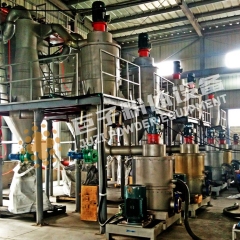
Shandong Borun Industrial Co., Ltd. is a leading edible alcohol production enterprise in Shandong Province and a "Key Agricultural Leading Enterprise of Weifang City." The company invested in a 20,000-ton annual production project for chlorinated polyethylene (CPE). After extensive investigation and comparison of domestic drying equipment manufacturers, our company's product performance and corporate reputation ultimately won the trust of the client. The equipment recommended by our company for Borun Co., Ltd. includes one YFG-4000 circular fluidized bed, one DSH-5000 double-screw conical mixer, and one set of large baghouse dust collector.
Currently, most domestic manufacturers use aqueous-phase processes to produce CPE. Our company has successfully developed four CPE units, all employing advanced hydrochloric acid-phase technology. Through continuous innovation, we have achieved CPE reaction, washing, and direct drying in high-concentration hydrochloric acid solutions, eliminating the neutralization step. This results in a product with no salt content, higher purity and whiteness, while the by-product hydrochloric acid can be recycled, with no waste acid discharge.
Advanced technology endows CPE products with better elasticity and a rubber-like feel, giving products a fine, soft, and smooth appearance. This makes them especially suitable for high-end applications such as plastics and rubber.
1. Design Conditions for the Specialized Drying Equipment for Chlorinated Polyethylene
1. Material Conditions
Material Name: CPE
Initial moisture content: 10%-30% (calculated at 30%)
Final Moisture Content: <0.3%
Feeding amount: 6000 kg/batch
Bulk density of wet material: 0.56 g/cm²
Raw material temperature: 15°C (designed based on room temperature)
Product temperature: 35-40℃
2. Process Conditions
Drying method: circular fluidized bed
Material-to-hot air contact method: direct type
Heat source and heating method: Steam heating (0.6-0.7 MPa, 120°C)
Dry air inlet temperature: 110–120°C (design value: 120°C)
Dry exhaust air temperature: ≤75°C (design value taken as 75°C)
Product discharge method: circular fluidized bed main unit
Dust removal method: cyclone separator
3. Design Meteorological Conditions
Atmospheric pressure: 101.325KPa
Ambient temperature: 15℃
Relative Humidity: 80%
4. Utilities
4.1 Power Supply
Power Supply: 380V, 3-phase, 50Hz
Power: 324.1kW
II. Description of the Principle and Process Flow of the Specialized Drying Equipment for Chlorinated Polyethylene
1. Process Flow:
CPE wet material enters the dryer under the action of positive pressure air supply. The material is dried by filtered fresh air entering the heater for heating, and the heated hot air is blown into the dryer from the bottom. The material inside the dryer is fluidized under the combined effect of stirring and hot air until the drying process is completed. The dried CPE material is discharged into a hopper via the dryer discharge valve, then enters the dried CPE granular material silo through the hopper discharge valve. Fine particles are sent to a grinding mill for pulverization and then enter a filter separator. The CPE powder is transported to the packaging CPE silo via the discharge valve using process air. During the drying process, the CPE powder carried by the exhaust gas is separated by a cyclone separator and blown back into the dryer using compressed air. Hydrogen chloride in the tail gas is neutralized and absorbed in a scrubber. The washing water is collected at the bottom of the scrubber and returned to the washing water tank. Alkali solution is added periodically, and the washing water is circulated using power provided by the washing water pump. Excess water overflows to the wastewater treatment station. The exhaust gas generated during the grinding and pulverization process is drawn out by the induced draft fan of the filter separator and discharged into the atmosphere, ensuring that the tail gas meets emission standards.
2. Basic Principles:
The purified hot air is blown in from the bottom of the perforated plate of the dryer. Under the stirring action, it fully contacts the material, causing the material inside the dryer to be in a fluidized state. CPE material particles float up and down in the hot air, colliding and mixing with each other, while mass and heat transfer occur between the gas and solid phases. This allows the moisture and residual hydrogen chloride gas in the material to fully volatilize, thereby achieving the purpose of drying.
3. Actual Design Process:
Based on the material characteristics and the results of bilateral discussions, pneumatic conveying equipment and fluidized bed drying equipment are selected for intermittent connection. After centrifugation, the material is positively pressurized by a fan and sent into the air inlet, where the fan pneumatically conveys the material into the fluidized bed drying chamber. The two sets of equipment share a single feeding port, with a pneumatic control valve regulating the feeding branch pipes. Simultaneously with feeding, the drying supply fan and induced draft fan are activated, causing the material to form fluidized drying under the action of high-speed airflow. The material completes drying after a certain period of fluidization. Once drying is complete, the discharge door is opened, and the material is expelled from the main unit by pneumatic force.
Since the material undergoes centrifugal dewatering, the company considers that the material may form agglomerates due to centrifugal action. Therefore, during material conveying, the material is positively pressurized by the fan to achieve a crushing effect. The equipment uses a cyclone separator for dust collection, while the exhaust gas is collected and purified by a water mist dust collector to ensure the desired performance.