- Products
-
Shops
AI Search
Unlike other ceramic materials, zirconia (ZrO2 - also known as zirconium dioxide) is a material with very high resistance to crack propagation. Zirconia ceramics also have very high thermal expansion, making them a frequently chosen material for joining ceramics and steel.
Tyco is continuously developing specialized application materials. Below, you will find our **products, including their endurance limits that are among the best in their class**. Please contact Tyco for more information.
Worth knowing.::
High thermal expansion (α=11×10⁻⁶/K, similar to certain types of steel)
Excellent thermal insulation / low thermal conductivity coefficient
(below 2.5 to 3 W/mK)
Very high resistance to crack propagation, high fracture toughness (6.5 to 8 MPa·m¹/²)
Capable of conducting oxygen ions (used in lambda probes for measuring oxygen partial pressure)
Partial stabilized zirconia material
Background
Zirconia (zirconium dioxide) is an excellent engineering ceramic due to its ideal physical properties, such as a very high melting temperature, high strength, and fracture toughness with **excellent wear resistance**, which is advantageous for several dental and orthopedic applications. However, the phase transformation that occurs during its sintering process is detrimental to these properties, making pure zirconia not a useful engineering material.
Periodic changes in zirconium oxide
At room temperature, zirconia exists in the monoclinic phase. When heated to approximately 1170°C, it undergoes a phase transition from monoclinic to tetragonal, accompanied by a volume shrinkage of 3-5%. Further heating results in another transformation to the cubic phase at 2370°C.The cubic phase remains stable up to the melting point or until zirconia reaches 2680°C.
The large volume change associated with this phase transition is significant enough to affect the structural integrity of the material. Repeated heating and cooling cycles will further erode mechanical integrity and performance.。
Production is stable, with partially stabilized zirconia.
The addition of cubic oxides, such as magnesium oxide, calcium oxide, Y₂O₃, cerium oxide, and other rare earth oxides, stabilizes the high-temperature cubic phase in all ways down to room temperature. They also tend to lower the phase transition temperature.
In partially stabilized zirconia, phase transformation toughening
If properly produced, the resulting microstructure consists of lenticular or elliptical precipitates within the cubic grains of tetragonal zirconia. Typically, the tetragonal phase will transform into the monoclinic phase at sufficiently low temperatures, but the high-strength cubic phase prevents the required expansion from occurring, causing the tetragonal precipitates to freeze. Monoclinic zirconia may also exist within the cubic grains and at grain boundaries.
Typical Properties of Partially Stabilized Zirconia
Excellent fracture toughness
Excellent wear resistance.
Excellent impact resistance
Good resistance to thermal shock.
Good chemical resistance
Good corrosion resistance.
| Applications of Partially Stabilized Zirconia Casting and Molds Knife, scissors, and blade Wear-resistant components, including bearing liners Water pump accessories grinding media |
Yttria-stabilized zirconia
Yttrium oxide serves as a stabilizer. This material primarily has a tetragonal crystal structure. Yttria-stabilized zirconia exhibits the **flexural strength** of all zirconia-based materials, especially during hot isostatic pressing. The fine grain size of yttria-stabilized zirconia makes it suitable for use in cutting, enabling the achievement and maintenance of a very sharp edge on tools due to its high wear resistance.
The fine grain size results in a very dense, non-porous ceramic with excellent mechanical strength, corrosion resistance, impact toughness, thermal shock resistance, and very low thermal conductivity. Due to its properties, yttria-stabilized zirconia is used for wear parts, cutting tools, and thermal barrier coatings.
Main Features
Excellent mechanical strength
Excellent wear resistance.
High impact resistance
Very low electrical conductivity
Main applications
Structural ceramics
Wear-resistant parts
Thermal barrier coating
Dental ceramics
Fiber optic
Sealing gasket and casing
grinding media
Oxygen sensor
Cerium-stabilized zirconia
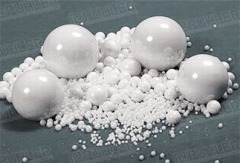
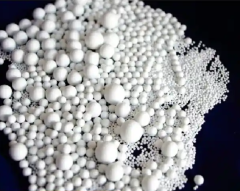
Cerium oxide is used as a stabilizer to produce zirconia ceramics with a density of **6.2 g/cm³**. Due to the material's excellent wear resistance and high density, it is used to produce grinding media, especially for milling high-viscosity compounds and coatings. The higher density also allows for the production of smaller grinding media, leading to higher grinding efficiency and reduced grinding time.
The wear resistance, fracture toughness, and mechanical strength are similar to those of yttria-stabilized zirconia.
Main Applications:
grinding media
Structural ceramics
Automotive catalytic system
Main Features:
high density
Excellent wear resistance
High impact resistance
Good fracture toughness.
Magnesium-stabilized zirconia
Magnesium oxide is used as a stabilizer. This cubic phase material incorporates small tetragonal precipitates, achieving a very high level of transformation toughness. Magnesium-stabilized zirconia can provide fracture toughness.*High level. It possesses excellent mechanical properties, including high strength, fracture toughness, wear resistance, good thermal shock resistance, and low thermal conductivity.
Due to these properties, it can be found in high-wear and corrosion applications, including valves, pumps, and gaskets. It is a material of choice for the chemical processing and petrochemical industries.
Main Features:
Excellent fracture toughness
Excellent wear resistance.
Corrosion-resistant
Good thermal shock resistance.
Main Uses:
Water pump accessories
Valve assembly
bearing