- Products
-
Shops
AI Search
In fact, this is increasingly being applied to critical use cases across various industries.
Silicon carbide possesses the **best corrosion resistance** among all advanced ceramic materials. It also features high thermal conductivity, excellent thermal shock resistance, and very low thermal expansion characteristics. It is widely used in semiconductor processing, such as in polysilicon reactors, wafer polishing, etching, and CVD processes.
It also maintains its strength at temperatures up to 1400°C and offers excellent wear resistance and thermal shock resistance.
Its behavior is almost like a diamond. It is not only *light, but also *hard ceramic material, with good thermal conductivity, low thermal expansion, and high resistance to acids and alkalis.
Worth knowing:
Low density (3.07–3.15 g/cm³)
High hardness (HV10 ≥ 2200 GPA)
High Young's modulus (380–430 MPa)
High thermal conductivity (120–200 W/mK)
Low coefficient of linear expansion (3.6~4.1x10⁻⁶/K, at 20~400°C)
SISIC's excellent thermal shock resistance: ΔT1100K
Easily eroded
Corrosion resistance and wear resistance even at high temperatures.
Non-toxic
Good gliding performance.
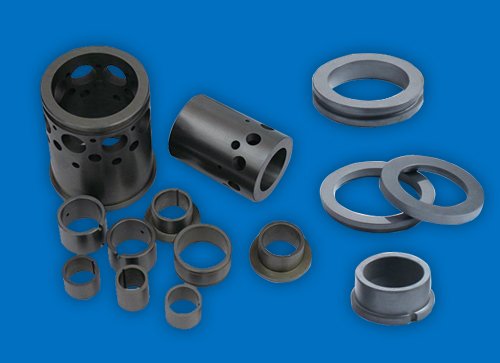
Silicon carbide is available in two forms: reaction-bonded and sintered. Both materials are extremely hard and possess high thermal conductivity. This makes silicon carbide suitable for use in bearing and rotary seal applications, where its increased hardness and electrical conductivity enhance sealing and bearing performance.
Using dynamic sealing technology, friction bearings and mechanical seals, such as those in pumps and drive metals, silicon carbide can provide a very cost-effective solution with longer tool life when dealing with aggressive, high-temperature media. Silicon carbide ceramics are also suitable for use in demanding conditions, such as in ballistic applications, chemical production, energy technology, and components for paper and pipe systems.