- Products
-
Shops
AI Search
One, Capacity Requirement:
1. Raw material: Feed; Raw material particle size: 10mm
2、 Product fineness: adjustable to 300 mesh
3、 Output: 300Kg/h. (Based on test data with a 1:1 input ratio)
II. Process equipment name:
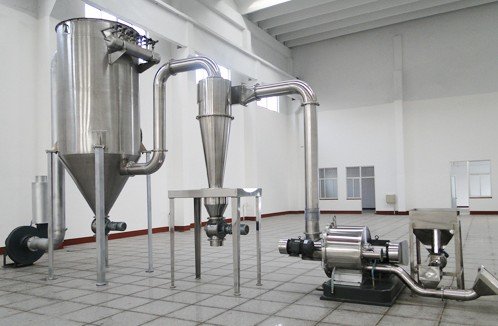
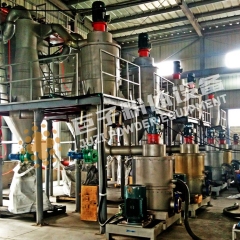
Crushing Production Line Model: CR600
III. Equipment Performance Parameters
1. Fineness: 300 mesh.
2. Output: 300 kg/h. (Based on test data with a 1:1 feed ratio)
IV. Process Flow: See attached diagram.
Quantitative feeding system → Grinding and classifying machine → Electro-pulse dust collector → Induced draft fan → Electrical control system
V. Process Plan Description:
This machine adopts an integrated design of automatic feeding, crushing, and classification, completing the crushing and classification processes in one go. The equipment has a simple structure and occupies minimal space.
1. **Hopper and Automatic Feeding System**: After materials are poured into the hopper, they are transported to the crusher inlet by an electric auger. The auger motor is controlled by a frequency converter, enabling automatic feeding and adjustable feeding volume.
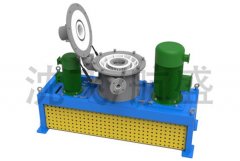
2. Grinder: Model CR600; mainly consists of a grinding section and a classification section:
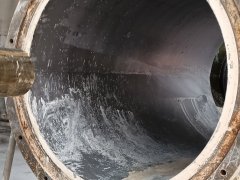
After the material enters the crushing zone, under the action of high-speed impact hammers and toothed plates, intense collisions, friction, and shearing occur, resulting in ultra-fine crushing of particles. The crushed material then enters the classification zone, where, under the action of the classifier, qualified materials are promptly separated and sent to the next stage for product collection, while materials that have not reached the required fineness continue to be crushed in the crushing zone. By adjusting the rotational speed of the classification turbine, products with different fineness requirements can be produced. The speed adjustment is achieved by controlling the frequency converter in the electrical cabinet, which is convenient and reliable. The crushing fineness is adjustable within the range of 120-600 mesh. The crushing chamber and classification chamber are cooled using water-cooled jackets. Since the material enters the crushing chamber with the airflow and is discharged out of the machine with the gas after qualification, the crushing temperature can be reduced. The main crushing machine is controlled by a frequency converter, reducing the impact of high-power motors on the factory's power grid.
3. Cyclone Collector:
The cyclone collector is mainly composed of several parts, including a cylindrical body, a conical body, a top cover, an intake pipe, an exhaust pipe, an ash collection hopper, and a pneumatic discharge valve.
Its working principle is as follows: when the dust-laden gas enters the outer cylinder at a high speed along the tangential direction from the intake pipe, the airflow changes from linear motion to circular motion. During this rotational motion, the solid particles experience a centrifugal force far greater than that of gas molecules, and the difference in centrifugal force is utilized to achieve gas-solid separation.
Determination of the main parameters of the cyclone collector:
Based on the determination of the parameters of the aforementioned jet mill and secondary classifier, the basic value of the system air volume was established. To achieve the collection efficiency of the cyclone collector**, a semi-circular spiral inlet cyclone collector was adopted, with the wind speed inside the cylinder body ranging between 3.5 and 5 m/s and the inlet wind speed ranging between 18 and 23 m/s, thereby determining the cyclone collector.
4. Electro-pulse dust collector: Mainly composed of the cylinder, pulse controller, pulse valve, back-flush pipe, filter bag, and cage. The fine powder not collected by the cyclone collector enters the baghouse dust collector with the airflow, adheres to the filter bags, and is filtered out. Under the action of high-pressure back-flush air, it is shaken off and collected at the bottom of the hopper, then discharged through an automatic discharge valve to obtain a first-grade product. The clean air is discharged through the fan, with a dust emission concentration of ≤35 mg/m².
5. The entire set of equipment is centrally controlled by a single electrical cabinet, offering high automation. It is convenient and reliable to operate, with the crushing motor, grading motor, and feeding motor controlled by frequency converters, and utilizing a PLC and color touch display.
6. The entire production line operates under negative pressure created by the induced draft fan, ensuring no dust leakage and providing an excellent working environment.
VI. Equipment Configuration and Parameters:
1. Automatic Quantitative Feeding System: Equipped with an electric screw automatic feeder.
a) Screw model: LX-110, power: 0.55KW, controlled by a frequency converter, with a feeding capacity adjustment range of 100-400 kg/h.
b) The single batch loading capacity of the hopper is 50 kg, and the equipment material is carbon steel.
c) The frequency converter is manufactured by Shenzhen INVT, model CHF100-1R5G/2R2P-4.
d) Equipment power: 0.55kW, cycloidal pinwheel reducer
Reducer model: XLD0.55-3-43
2. Ultrafine Impact Mill: Model CR600; mainly composed of a crushing section and a classification section.
a) The power of the crushing main unit is 30KW, with a frequency converter controlling the rotation speed, adjustable within a range of 1500–2600 rpm, and installed without a foundation.
b) The power of the classifier is 4KW, with a frequency converter controlling the rotational speed, adjustable within a range of 500–2900 rpm, and installed without a foundation.
c) The main engine inverter is manufactured by Shenzhen INVT, model CHF100-30G; the classifier inverter is manufactured by Shenzhen INVT, model CHF100-4R4G.
d) The equipment material is carbon steel, with a shell thickness of 20mm and a flange thickness of 20mm.
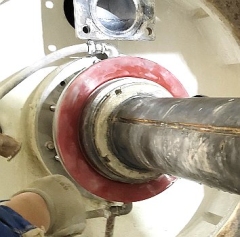
e) After welding, the crusher undergoes heat treatment to relieve stress. The classification impeller seal employs mechanical seals and gas seals, and the impeller is subjected to dynamic balance calibration.
f) The crushing disc is made of 304 stainless steel.
g) There are 12 impact hammers made of cemented carbide YG8.
h) The tooth plate is made of cast high-chromium wear-resistant steel.
i) The workbench is a welded assembly made of carbon steel (weighing 400 kg).
j) The crushing chamber and classification chamber are cooled by circulating water.
k) The main engine bearings are lubricated with oil and cooled by circulating water.
L) The bearing uses SKF, and the oil seal is imported from Japan.
M) The working door adopts a quick-release sliding door structure, and no lifting equipment or tools are required for disassembly and maintenance.
3. Cyclone Collector:
Model: XF500
Cylinder diameter: ¢500,
Cylinder thickness: 2.5~4mm
Flange thickness: 10–12 mm
Main Material: Carbon Steel.
Electric Discharge Valve: Model: YCD-6, Carbon Steel;
4 Dust Collectors: Model DC37, automatic electric pulse cleaning
a) Contains 37 coated needle-punched filter bags, with bag specifications of ¢135×2050.
b) The dust content after discharge is less than 30 mg/m³, and the collection efficiency is greater than 99.99%.
c) The equipment material is carbon steel, with a cylinder thickness of 3mm and a cone thickness of 3mm.
d) Manual discharge valve: Model: DN200, carbon steel.
5. Induced draft fan: Model 9-19 6.3A, power 11KW, with a simple installation foundation, should be placed outdoors, equipped with a silencer.
6) Electrical Control System:
a) The motors of the feeding system, crusher main unit, and classifier are controlled by Shenzhen INVT inverters.
b) Automatic pulse-jet cleaning control for the dust collector;
c) The main components are CHINT products.
Seven. Power composition of the production line: total 46KW
Feeding system: 0.55KW; Main machine: 30KW; Classifier: 4KW; Induced draft fan: 11KW;
VIII. Factory Area Requirements: The process flow diagram is for reference only; the connection positions and directions between equipment can be arranged according to the factory requirements.
9. Supply Details:
1) Host Part (for reference only, subject to the contract)
Serial number Name Specifications and Models Quantity Notes
1.Feeding device Material silo and automatic feeder Supporting 1 unit, carbon steel
Electric Feeder LX-110 1 unit, carbon steel
2.Crushing and Classification
machine Crusher main unit CR600 1 unit
1、 Carbon steel
2、 The crushing main chamber and classification chamber are cooled using circulating water.
3、 The main crusher bearing uses oil lubrication and circulating water cooling.
4. There are 12 impact hammers made of cemented carbide YG8 in total.
5. The tooth plate is made of cast high-chromium wear-resistant steel.
6. The bearing uses imported SKF, and the oil seal is imported from Japan.
7. The body cover door adopts a push-pull hinge structure, making it easy to disassemble and maintain.
8. The motors of the crusher and classifier are controlled by frequency converters.