- Products
-
Shops
AI Search
I. Overview of AF Series Classifier Products:
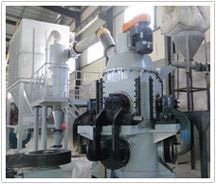
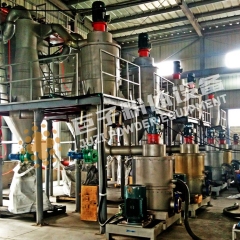
The AF series air classifier is a type of air classification technology featuring a square cylindrical structure as its main body. This technology replaces the rotating airflow field of the traditional circular cylindrical structure, enhancing material dispersion and thereby improving classification efficiency. This series of machines adopts a high-precision horizontal classification design, offering sharp cutting effects, excellent cutting accuracy, and superior large-particle control performance. Additionally, the machine incorporates a hinged connection structure for the classification wheel, allowing the classification impeller to be removed, which makes gap adjustment and maintenance very convenient. This reflects a human-centered design philosophy.
The AF series is suitable for dry classification of ultrafine powders, especially for the classification of large-scale industrial products.
II. Working Principle of the AF Series Classifier:
The AF classifier is a forced centrifugal classifier equipped with secondary air intake and a vertically installed classifying rotor. It consists of a classifying rotor, guide vane rectifier, feeder, and other components. Material is added from the upper casing, where the primary air from the outside performs an air-sieving action on the material, fully dispersing the particles and lifting them to the classification zone. Due to the high-speed rotation of the classifying rotor, the particles are subjected to both the centrifugal force generated by the classifying rotor and the centripetal force caused by the viscous effect of the airflow. When the centrifugal force on a particle exceeds the centripetal force, i.e., coarse particles above the cut size, they spiral down along the container wall. The external secondary air is rectified into a uniform swirling flow through the guide section, effectively separating fine powder mixed or adhered to the coarse particles. After separation, the coarse particles are discharged from the lower coarse particle outlet, while fine particles below the cut size are carried by the airflow through the classifying rotor into a cyclone separator and collected by a collector. The purified gas is then discharged through the induced draft fan.
III. Characteristics of the AF Series Classifier:
In addition to the many advantages of the AB series models, it also has the following features:
Wide Classification Range: This machine has strong adaptability to materials with different properties, specific gravities, particle shapes, and particle sizes, offering a broad classification particle size range, with d97 reaching 4 to 200 μm.
High Classification Precision: A complete and stable classification flow field, combined with reliable special sealing, enables high-sharpness classification of materials, resulting in a narrow particle size distribution and strict control over large particles.
High Classification Efficiency: It adopts a low-speed vertical single-impeller classification system, combined with a strong vortex field and a fine powder purification device, resulting in low installed power, high processing capacity, high fine powder extraction rate, and a classification efficiency of up to 95%.
Equipped with a strong dispersion device, it can effectively disperse and classify agglomerative materials.
IV. Applicable Scope of the AF Series Classifier:
Combined with various crushing equipment (such as jet mills, ball mills, Raymond mills, vibration mills, etc.) to separate fine powder.
Remove excessively fine or coarse particles from the material to effectively address the entrainment phenomenon.
Divide the material into several particle size segments based on particle size, which can replace the water method for producing abrasives.
The air classifier produced by our company achieves powder classification through the centrifugal force generated by the rotation of the impeller. Its structural forms include vertical and horizontal types, and it can be used in single-stage or multi-stage series configurations in practical applications.
Structural Features of Single-Stage Vertical Classifier: The impeller of this classifier is placed vertically and concentric with the cylinder body. The diameter of the classifying impeller ranges from tens of millimeters to several thousand millimeters, and the classifying power can range from a fraction of a kilowatt to several hundred kilowatts. The classification fineness can range from tens of mesh to several thousand mesh.
Product Overview of Multi-Stage Vertical Classifier: This machine is composed of single-unit vertical classifiers connected in series, enabling the simultaneous classification of materials into multiple grades of products.
V. Technical Parameters of AF Series Multi-Stage Vertical Classifier:
Model | Processing capacity (t/h) | Grading fineness (μm) | Classification Efficiency (%) | Classification Host Power (kW) | Installed Power (kW) |
AF050 | 0.1~0.5 | 2~100 | 70-85 | 5.5 | 30 |
AF100 | 0.5~1.0 | 2~100 | 70-85 | 11 | 45 |
AF200 | 10.~3.0 | 2~100 | 70-85 | 22 | 70 |
AF400 | 2.0~8.0 | 2~100 | 70-85 | 37 | 95 |
AF600 | 5.0~15 | 2~100 | 70-85 | 45 | 120 |
AF800 | 10~25 | 2~100 | 70-85 | 55 | 200 |
AF1000 | 20~50 | 2~100 | 70-85 | 75 | 250 |
AF1200 | 50~100 | 2~100 | 70-85 | 110 | 360 |
AF1600 | 80~150 | 2~100 | 70-85 | 132 | 400 |
AF2000 | 200~300 | 2~100 | 70-85 | 160 | 500 |
SixFlowchart of the AF Series Multi-Stage Vertical Classifier:
**Series of Images**