- Products
-
Shops
AI Search
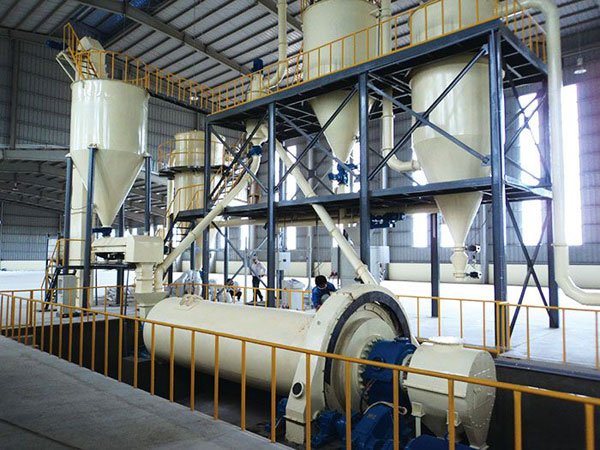
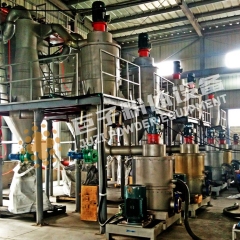
Working Principle of Ball Mill Classification Production Line:
After coarse crushing, the material is transported to the storage bin by an elevator and then fed into the ball mill through a controllable feeding device. The grinding media inside the mill, utilizing the kinetic energy obtained from the mill's rotation, repeatedly impact, grind, and crush the material. The crushed material is discharged from the tail of the ball mill into a suction tank and then transported by negative pressure to the classifier for classification. The qualified fine powder is collected by a cyclone collector or dust collector, while the coarse particles after classification are discharged from the lower end of the classifier and re-entered into the ball mill through a material conveying pipe for further crushing. The purified gas is discharged by an induced draft fan.
Performance Features:
● The process is directly derived from German technology and is an international standard non-metallic mineral processing production line.
● The process flow mainly includes crushing (typically two-stage crushing), grinding, classification, packaging, storage, conveying, and lifting. After the ball mill, multiple classifiers can be connected in parallel for classification, or multiple classifiers can be connected in series to simultaneously produce products of multiple particle sizes. The ball mill and classifiers form a closed-loop circulation system.
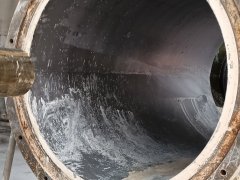
The selection and configuration of ball mills are based on non-standard designs tailored to the hardness, grindability, processing particle size, and output of the minerals. The shape of the liners and the grading of balls (or segments) are customized according to years of engineering practice experience, maximizing the grinding efficiency of the ball mill while reducing product energy consumption.
● The selection of classifiers can be tailored to different product fineness levels. The FW series classifiers are suitable for classifying products with D97: 2–20 microns, while the FL series classifiers are suitable for classifying products with D97: 8–45 microns. Each classifier offers a wide range of product adjustment, ensuring broad market adaptability.
● When a single production line is used to produce multiple varieties simultaneously, multiple classifiers can be connected in series. Through the optimized combination of coarse and fine classifiers, the energy consumption of the product is minimized, the particle size distribution is adjusted in the optimal direction, and the over-grinding phenomenon of the ball mill is reduced to the lowest level.
● Based on the client's investment scale, we can design and adopt different plant structures and equipment layouts, providing cost-effective ** configuration systems. For example, for an annual production capacity of less than 20,000 tons, the equipment layout typically uses a single-story plant with a flat layout, the conveying system employs screw conveyors, and packaging can be done manually. For capacities exceeding 20,000 tons, the equipment layout adopts a multi-story plant with a vertical layout, the conveying system uses pneumatic conveying, and packaging is automated with a palletizing system.
● In terms of environmental protection, we have adopted a special design that incorporates soundproofing devices, vibration reduction, and partial flexible connections to keep noise levels below 80 dB(A). By using high-quality membrane filter bags, the dust emission is reduced to less than 20 mg/m³.
● The electronic control system adopts program control to manage the entire production process, from the feeding hopper, grinding and classification, to product packaging.
● We can provide customers with additional services, such as mineral processing, modification, granulation, and the renovation and upgrade of existing production lines. By extending services to both ends of the product chain, we ensure the **maximization** of user benefits.