- Products
-
Shops
AI Search

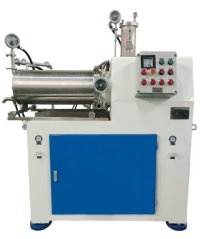
One,Introduction to Sand Mill
① What is a sand mill?
A wet bead mill is a machine that refines powder to the nanoscale.
Crushing by stirring with grinding beads in a grinder.· Decompose · Disperse powder (slurry) in liquid.
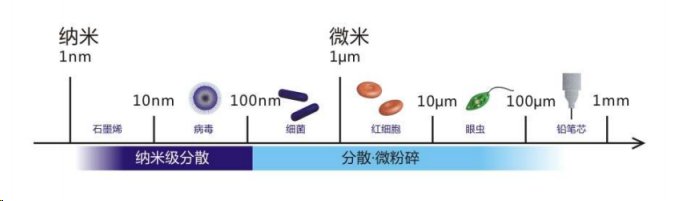
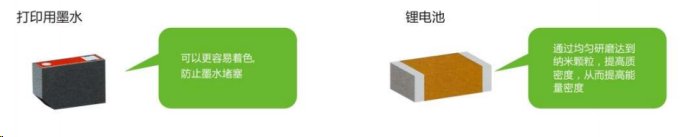
② What effect does using a sand mill to make particles finer actually have?
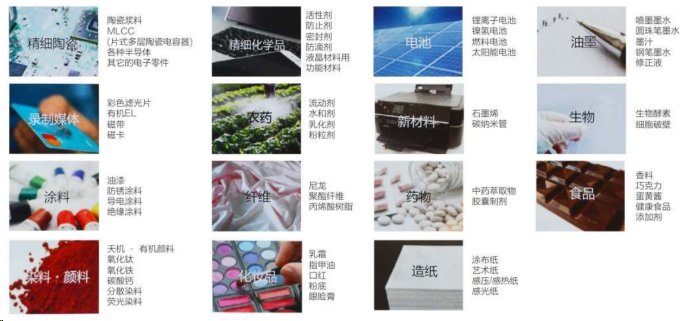
③ Products that can be used with a sand mill:
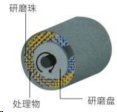
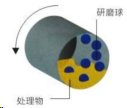
④ What happens in the sand mill?
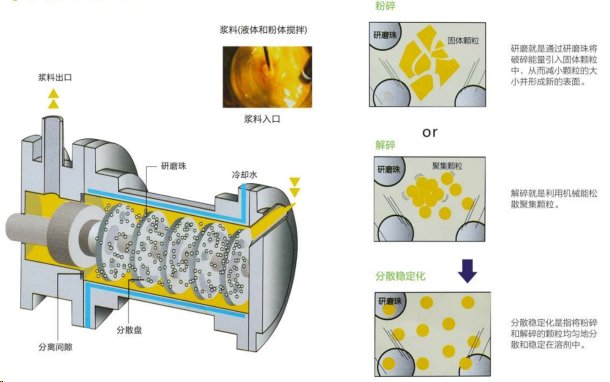
⑤ Comparison between Sand Mills and Ball Mills
Types of Crushers | Sand mill | Ball mill |
The particle size of the grinding beads | Φ0.03-2.0mm | Φ5.0-50mm |
Filling rate inside the container | 70-85% | 30-40% |
Number of grinding beads | 100,000 | 100 pieces |
The mass of a single particle is greater than | 1 | 1000 |
Impact force | 100-500G | 0.5-1G |
Processing graphics |
|
|
⑥ Single-Bucket Cycle Color Chart / Double-Bucket Cycle Color Chart
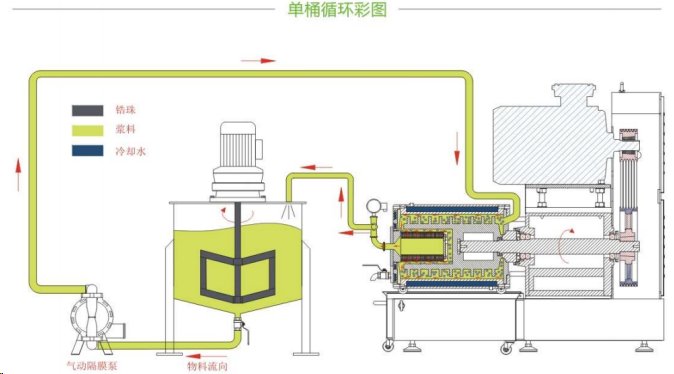
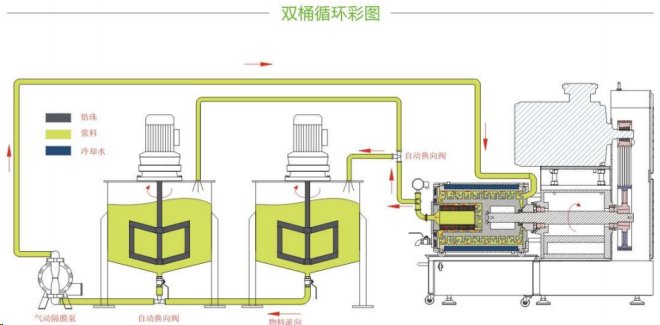
⑦ Working principle of the sand mill:
A sand mill is a type of wet ultrafine grinding equipment.It evolved from ball mills and is widely used in the production of ultrafine powders (submicron and nanoscale powders). Sand mills can be classified in different ways: by the structural shape of the stirring shaft, they can be divided into disc type, turbine type, and pin type; by the arrangement of the grinding chamber, they can be categorized as vertical or horizontal; they can also be distinguished by the volume of the chamber.
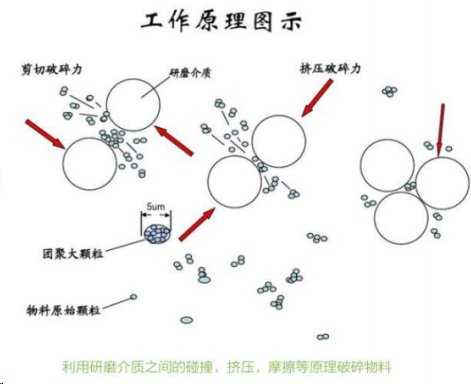
⑧ The Development History of Sand Mills
The development of sand mills has generally gone through the following stages.:
**StageVertical Agitating Mill (Rod Type + Bottom Screen Separator) Phase 2: Vertical Disc Sand Mill (Disc Type + Top Screen Separator) Phase 3: Vertical Rod-Pin Sand Mill (Rod Type + Top Gap Separator)
The fourth stageHorizontal Disc Sand Mill (Disc Type + Dynamic Gap Separator) (Rod Type + Large Filtration Area Separator) Fifth Stage: Vertical Rod Pin Sand Mill (Rod Type + Screenless Centrifugal Separation) Suitable for Small Batch Production
Horizontal Pin Sand Mill (Pin Type)+Large Filtration Area Separator (Rod Type + No Screen Centrifugal Separation) Suitable for Mass Production
⑨ Main indicators of the sand mill
A. Flow rate of the sand mill: affects product fineness, output, and particle size distribution.
B. Stirring shaft linear speed: affects grinding efficiency, material fineness, and wear. The linear speed influences the kinetic energy intensity applied by the grinding media to the material particles, typically ranging from 8 to 16 m/s.
C. Media Size: Affects grinding efficiency and product fineness. The smaller the media diameter, the more contact points between grinding balls and the smaller the contact gaps. In theory, the smaller the particle size of the ground material, but this also depends on multiple factors such as the feed particle size of the material. In summary, the appropriate size of grinding media should be used to grind materials of suitable particle size.
D. Media filling rate: affects grinding efficiency and product fineness. A higher media filling rate leads to higher grinding efficiency, but an excessively high filling rate may cause excessive temperature rise in the sand mill or blockage at the outlet. A too low media filling rate results in low grinding efficiency, increased wear, and prolonged grinding time. The appropriate filling rate mass calculation method = effective volume of the sand mill × filling rate (70-85%) × media bulk density.
E. Medium specific gravity: Affects grinding efficiency and product fineness. The higher the specific gravity of the medium, the greater the kinetic energy, and the higher the grinding efficiency.
F. Separation gap size: The structure of the separator and the width of the gap determine the size of the grinding media. Generally, the diameter of the grinding media is 2-4 times the width of the separator gap in the sand mill.
II. Product Description
III. Main Features
Upgraded rod-pin grinding structure, with stronger power, high rotational speed, and stable and reliable operation.The dynamic screen system ensures high flow rates without clogging. It enhances the impact and shearing effects of the grinding media on the material, with excellent heat dissipation performance. Suitable for grinding materials with high dispersion difficulty and achieving efficient micron-level material grinding.
IV. Main Technical Parameters
Model | Net capacity of the grinding tank (L) | Motor power (KW) | Processing batch (L) | Media Size (MM) | Weight (KG) | Overall Dimensions (MM) |
MS-B5E | 5 | 11 | 30-200 | 0.6-2.0 | 850 | 820*650*1520 |
MS-B10E | 10 | 15 | 40-400 | 0.6-2.0 | 1050 | 1500*860*1780 |
MS-B30E | 30 | 37 | 100-900 | 0.6-2.0 | 1350 | 1930*950*1850 |
MS-B60E | 60 | 45 | 200-1200 | 0.6-2.0 | 1850 | 2500*1500*2200 |
◆Suitable fineness:10um-2nm
◆Media size:≥0.6nm