- Products
-
Shops
AI Search

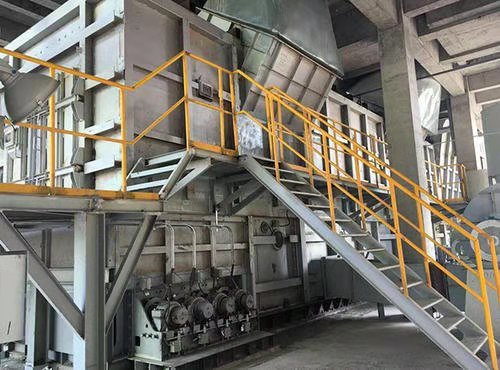
Product Introduction: The grate cooler is an essential cooling equipment in cement production lines. The grate cooler produced by our company is a new type of fourth-generation push-bar and material-stopping device grate cooler. During operation of the grate bed, no material accumulates in the air chamber, and the wall sealing is airtight. Compared with the first-generation horizontal push grate cooler, the second-generation grate cooler, and the third-generation air-beam grate cooler, the fourth-generation push-bar and material-stopping device grate cooler features a thicker material layer on the grate bed, higher productivity per unit grate bed area, eliminates the need for leakage sealing valves and small chain conveyors, and has a lower failure rate.
I. Structure and Working Principle of Our Company's Fourth-Generation Push Rod - Material Stopper Type Grate Cooler
The structure and working principle are as follows: Push rods with an acute triangular cross-section are secured to the grate bed by sealing grooves, pressing blocks, and bolts. They are arranged parallel to each other along the longitudinal direction of the grate bed at specified intervals. The grate bed, push rods, sealing grooves, pressing blocks, and linear bearings constitute the moving parts of the grate bed. Approximately 50 mm below the push rods, flat grate plates with labyrinth grate gaps are arranged in parallel. Below the flat grate plates is the fixed bed frame, to which the flat grate plates are firmly secured by bolts. The flat grate plates, fixed bed frame, and unit frames form the stationary parts of the grate bed. Each end of the grate bed consists of two rows of longitudinal beams and cross beams. The longitudinal beams extend upward from the fixed bed, and the gaps at their positions are surrounded by strip seals, end sealing boxes, etc., forming a dynamic sealing structure. During operation, this structure ensures no material leakage while allowing ventilation and cooling.
Between every two rows of thrust rods, a row of swing-type material retainers is fixed on the grate plate. The thrust rods, moving in a straight line, push the material forward during their forward motion (flat end), while during their return motion (pointed end), the material retainers prevent the material from flowing back. This significantly improves conveying efficiency, ensuring that the material consistently moves forward. Theory and practice have proven that this thrust rod-material retainer conveying system features low resistance and high conveying capacity.
A hydraulic cylinder device is installed between the movable frame and the fixed crossbeam beneath the stationary grate bed to provide power for the movement of the movable frame and the thrust bars.
The above components together form the unit grate bed, which is also the smallest unit constituting the entire grate bed of the grate cooler. The lower part of each working unit will be combined with the external frame and the intermediate partition wall to form an independent air chamber. There are no gaps between the air chambers for air leakage. Therefore, the lower air chambers of the modified grate cooler completely achieve separate air supply for the left and right air chambers. This creates conditions for overcoming material particle segregation and improving cooling efficiency, which is also a key difference from the third-generation grate cooler.
To ensure more uniform air distribution from the grate plates, an automatic adjustable air valve flange is installed beneath each fixed grate plate. Air valves are added at locations where truly necessary to reduce the phenomenon of blow-through short circuits caused by excessively low local wind resistance.
At the hot end of the grate cooler, i.e., the lower end of the kiln outlet, a set of fixed injection grate beds is installed. The high-temperature clinker falling onto the upper part of the grate beds moves forward continuously through natural accumulation and the impact kinetic energy of the material. At the same time, 2 to 3 fans arranged below the grate beds supply high-pressure airflow into the fixed chamber. This airflow can be directed upward and horizontally through the grate plates toward the material, enabling sufficient heat exchange and rapid cooling of the material. This is beneficial for improving the overall cooling effect, enhancing clinker reactivity, and increasing kiln temperature.
To prevent snowmen from piling up and to remove them more effectively, an air cannon nozzle was installed inside the fixed bed grate plate, connected to the air cannon via internal piping. Practice has proven that this structure is effective.
II. Technical and Structural Features of the FLBT Series Grate Cooler:
1) The improved inlet fixed bed system, combined with optional air cannons or hydraulic pusher solutions in various forms, not only achieves excellent clinker rapid cooling effects but also prevents the occurrence of the "snowman" phenomenon.
2) Different grate plate configurations and controllable refined air supply in various units and areas make the cooling air distribution more uniform, effectively eliminating the "red river" phenomenon.
3) High cooling efficiency, low clinker discharge temperature, and excellent quality, with strong adaptability to clinker and firing conditions (including granulation, output, etc.).
4) Excellent heat recovery effect: On the basis of providing high and stable secondary and tertiary air, it can reliably supply waste heat for power generation and drying air as needed, while the exhaust gas temperature entering the kiln head dust collector is low.
5) The meticulously designed high-rigidity grate bed structure ensures uniform gaps in the grate bed, significantly enhancing its resistance to abnormal conditions (such as kiln skin collapse, large clinker balls, etc.) and preventing issues like bed pressing.
6) The high-quality selection or design of critical and important components with ample margins significantly enhances the reliability of the equipment.
7) The specially structured anti-wear grate plates and streamlined labyrinth-type grate gaps ensure uniform air distribution and excellent airflow permeability, while also minimizing wear on the entire grate bed and extending its service life.
8) Based on a modular design, it allows for the combination of modules to achieve different production capacities.
9) High operational rate, ensuring that production is not affected by issues with the cooler.
III. Specifications of the FLBT Series Fourth-Generation Pushing Bar Grate Cooler