- Products
-
Shops
AI Search

I. Working Principle
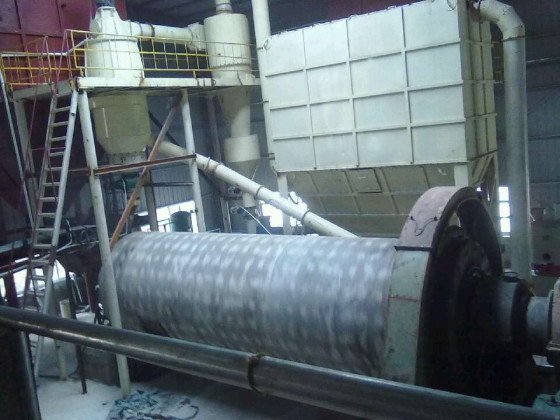
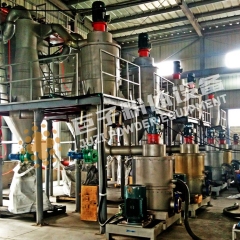
After coarse crushing, the material is transported by lifting equipment into an ultra-fine ball mill. The grinding media inside the mill, utilizing the energy gained from the mill's rotation, impact and grind the material to achieve crushing. The crushed material then enters a self-classifying micro-powder classifier through a discharge bin for classification, achieving separation of coarse and fine powders. The qualified fine powder is collected by a collector, while the coarse particles re-enter the ball mill from the lower end of the classifier for further crushing. The purified gas is discharged by an induced draft fan.
II. Performance Advantages and Features
The ultra-fine ball mill classification production line is a new energy-saving and high-efficiency grinding production line that **combines** ultra-fine ball milling technology with self-flowing fine powder classification technology.
1. The standout feature of the new-generation ultra-fine ball mill classification production line is its revolutionary progress and breakthrough in energy-saving technology and classification accuracy compared to other ball mill classification production lines, achieving over 40% energy savings compared to other ball mill classification production lines and other types of mills.
2. The fineness of one-time classification can be adjusted arbitrarily between 300 and 2500 mesh. With an additional classifier system, after secondary classification, the fineness can reach d97 ≤ 2μm (6250 mesh), achieving the current high level of dry classification both domestically and internationally.
3. The adoption of the new self-diverting high-concentration classification technology in the ultrafine ball mill classification production line achieves: high classification precision and accurate cut point; large processing capacity, with the **single-unit processing capacity of the LHB series classifier reaching up to 100 t/h**; low energy consumption, with energy consumption only 40% of that of other classifiers for the same processing capacity; and high classification efficiency, with the fine powder extraction rate increased by 50% compared to other classifiers for the same processing capacity.
4. The ultra-fine ball mill has undergone innovative design, significantly improving crushing efficiency. With a scientifically optimized media ratio, it can effectively produce a large quantity of micro-fine powder.
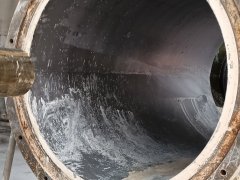
5. Depending on the material, appropriate liners and grinding media can be selected to ensure the purity and whiteness of the product.
6. The system design is more rational, reducing investment in civil engineering and auxiliary equipment by 50% compared to other ball mill classification production lines.
7. Low equipment failure rate and stable operation; the system adopts intelligent frequency conversion control with a high degree of automation; the negative pressure flow field design ensures an excellent production environment.
8. High production capacity.
III. Application Areas
Soft Materials: Calcite, marble, limestone, kaolin, gypsum, barite, fly ash, slag, etc.
Hard Materials: Silicon carbide, brown corundum, mullite, ultrafine cement, zircon sand, andalusite, refractory materials, etc.
High-Purity Materials: Quartz, feldspar, α-alumina, glass beads, phosphors, etc.
Metallic Materials: Zinc powder, aluminum powder, iron powder, molybdenum powder, etc.