- Products
-
Shops
AI Search

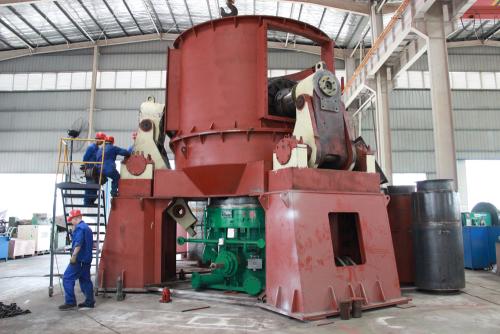
FLPM Vertical Roller Press
One,Vertical Roller Press Grinding System(Cement Grinding **Plan**)
In the cement production process, grinding power consumption (raw material grinding + cement grinding) accounts for about 70% of the total power consumption in cement production. Therefore, reducing grinding power consumption is key to energy conservation in the cement industry. So, how can power consumption be reduced?
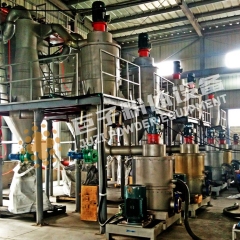
The independently developed by our companyVertical roller pressIn response to the requirements for energy conservation and consumption reduction, a new type of pre-crushing equipment specifically designed for cement has been developed by addressing the shortcomings of the conventional roller press grinding system. Taking the Φ3.2×13m open-circuit ball mill as an example, the addition of a vertical roller press increases power consumption by one-third while doubling the output.
Comparison between FLPM Vertical Roller Press and Ordinary Horizontal Roller Press
| Comparison between FLPM Vertical Roller Press and Ordinary Horizontal Roller Press | |||
| Project | FLPM Vertical Roller Press | Ordinary horizontal roller press | |
| Mechanism of Grinding | The grinding process is achieved through pressure and shear stress. | The grinding process is completed solely through pressure. | |
| Grinding efficiency | The effective combination of pressure and shear stress results in high grinding efficiency. Under the same conditions, the system's power consumption per ton of cement is 3 kWh lower than that of a roller press system. | Due to the grinding process being solely under pressure, the product fineness cannot reach the fineness level of FLPM vertical roller mill products. | |
| Material moisture adaptability | The comprehensive moisture content of the material is required to be ≤3%, but the system can still operate normally even at **5%**. Since its product is not a material cake, normal powder selection is possible. As a result, the requirements for the moisture content and type of mixed materials are relatively lower, which can reduce cement costs. | Requirement ≤1.5%. If the moisture content is too high, the material cake will not be easily broken apart, affecting the classification efficiency and thereby reducing the system's output. | |
| Operational stability | Operational stability | >95%, fewer mechanical failures | There are many mechanical failures, resulting in low operational efficiency. |
| Adaptability to output fluctuations | Easy to operate, FLPM easily adapts to production fluctuations because the feed rate equals the discharge rate, requiring no control. | The operation is complex, requiring adjustments to the circulation volume to accommodate changes in the feed rate in order to maintain the material level in the small bin before the mill. | |
| Adaptability to grindability | The product fineness adjustment range is wide because it is achieved by changing the roller pressure and the height of the retaining ring. | The product fineness adjustment range is narrow because it only adjusts the product fineness by changing the roller pressure. | |
| Impact of Roller Wear | Minimal wear, thus having very little impact on the material bed thickness and product fineness. Roller lifespan exceeds 30,000 hours. | Due to uneven wear, performance significantly decreases, causing the product particle size to become coarser. The interval between each roller repair is approximately 4,000 to 8,000 hours. | |
| System supporting auxiliary equipment | The material undergoes 3-4 passes of compression within the FLPM roller press mill, resulting in high crushing efficiency. The mill's circulation volume is significantly reduced compared to that of a roller press, thereby decreasing the capacity of the circulating bucket elevator and the classification air volume by 20%-30% relative to a roller press, leading to a reduction in system power consumption. | Since the roller press only performs a single compression and there is an edge leakage effect (material at both edges of the rollers passes through without being compressed), to achieve the required product fineness for the system, the mill circulation rate must be increased, allowing the material to pass through the roller press multiple times. As a result, the capacity of the circulation elevator is large, leading to high energy consumption for non-productive work. | |
| System equipment investment | The investment in system equipment is lower than that in the roller press system. | The investment in system equipment is relatively high. | |
| System civil engineering investment | The floor area is similar to that of a roller press. | Close | |
| Repair cost | Wear-resistant parts have a long service life and are easy to replace, with replacement completed within 1-2 days. Mechanical failures are rare, and the maintenance cost per ton of cement is approximately 1/10 of that of a roller press. | The roller has a short service life and requires frequent hardfacing. Additionally, care must be taken to prevent the welding layer from falling off or peeling, resulting in high maintenance costs. | |
| Construction or renovation cycle | About 2 months | The cycle is relatively long. | |
II. Characteristics of the Cement Grinding System with a Vertical Roller Press
Below, the FLPM1700 vertical roller press and the φ3.2×13m cement mill grinding system are used as an example to introduce the characteristics of the vertical roller press grinding system.
2.1 Process Flow Diagram of the Grinding System
2.2 Comparison between the cement grinding system with a vertical roller press and the open-circuit mill system is shown in the table below.
| Category | Open-circuit cement grinding | Vertical roller press + ball mill system |
| Ball mill model | Φ3.2×13m,1600KW | Φ3.2×13m,1600KW |
| Vertical Roller Press Model | — | FLPM1700,355KW |
| Cement type | PO42.5 | PO42.5 |
| System output, t/h | 50 | 110 |
2.4 This system is suitable for new cement production lines as well as the upgrade and renovation of existing production lines.
3. Comparison of cement fineness and specific surface area between the roller mill semi-finish grinding system and the roller press semi-finish grinding system
| Project | 45μm sieve residue, % | Specific surface area, cm²/g |
| JS Plant Roller Mill Semi-Final Grinding | 9.9 | 4260 |
| 10.4 | 4280 | |
| 10.3 | 3990 | |
| Semi-final grinding with roller press in SD plant | 1.3 | 3470 |
| 5.9 | 3300 | |
| 2.0 | 3620 | |
| Semi-final grinding with roller press from JY factory | 5.8 | 3220 |
| 3.8 | 3690 | |
| 3.3 | 3110 |
The 45μm sieve residue of the cement product from the roller press is much smaller than that from the roller mill, yet its specific surface area is lower than that of the cement product from the roller mill. This indicates that the particle size distribution of the cement product from the roller press is unreasonable, with a low content of particles <10μm, especially 3μm particles, and a high content of large particles. In contrast, the relationship between the specific surface area and the 45μm sieve residue of the cement product from the roller mill is comparable to that of the ball mill product, suggesting that the particle size distribution of the cement product from the roller mill is closer to that of the ball mill product. Additionally, to increase the specific surface area of the cement product from the roller press, it is necessary to raise the rotational speed of the classifier, which will reduce the amount of finished product selected, inevitably lowering the system output.
4. Specifications of Fulanke Heavy Industry Vertical Roller Press
| Model/Type Technical Parameters | Materials entering the mill Granularity mm | Feed material Water % | Throughput t/h | Output fineness Specific surface area cm²/g | Motor power KW |
| FLPM 1300 | ≤30 | ≤5 | ≤52 | 180 | 200 |
| FLPM 1500 | ≤30 | ≤5 | ≤75 | 180 | 315 |
| FLPM 1700 | ≤30 | ≤5 | ≤120 | 180 | 355 |
| FLPM 1900 | ≤35 | ≤5 | ≤130 | 180 | 450 |
| FLPM 2200 | ≤40 | ≤5 | ≤200 | 180 | 630 |
| FLPM 2400 | ≤45 | ≤5 | ≤230 | 180 | 900 |
| FLPM 2600 | ≤50 | ≤5 | ≤260 | 180 | 1120 |
| FLPM 2800 | ≤50 | ≤5 | ≤300 | 180 | 1250 |
5. The vertical roller press can be combined with a ball mill to form different grinding systems, each with varying energy-saving effects. For details, please contact our company by phone, and we will provide you with the most reasonable configuration solution based on your needs.