- Products
-
Shops
AI Search

●Comparison with ordinary classifiers and ultrafine powder classifiers:
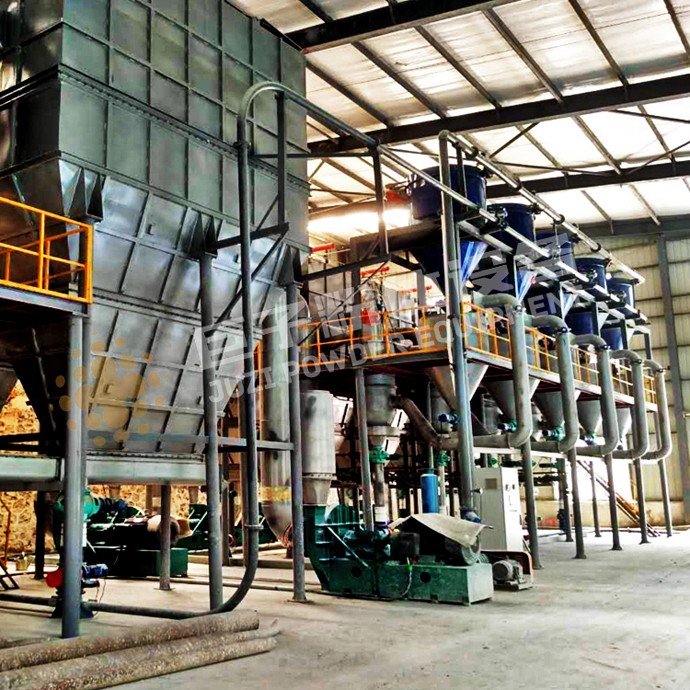
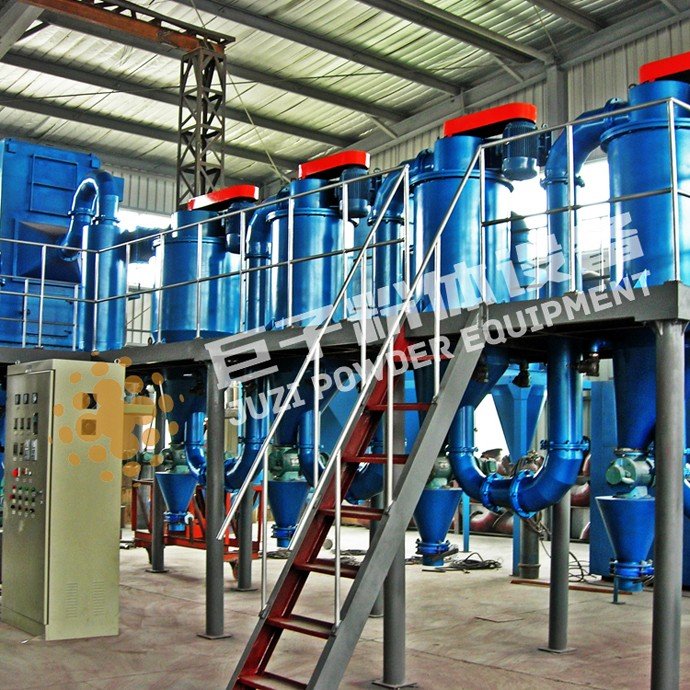
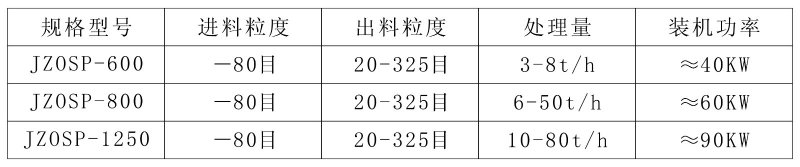
JZ0SPClassifier(Classifier)It is our company's traditionalO-SepaA new type of high-efficiency classifier successfully developed based on the classifier.,The formation and classification mechanism of its graded flow field are significantly different from those of centrifugal and cyclone classifiers.JZOSPThere are many differences between a classifier and an ordinary ultrafine powder classifier. An ordinary ultrafine powder classifier generally relies on centrifugal force control and is suitable for classifying particle sizes.2Micrometer to74Materials between micrometersJZOSPThe classifier is suitable for classification.10Micrometer to300Materials between micrometers. Due toJZ0SPThe classifier has a significant effect on increasing production and saving energy. Currently,0-SepaThe classifier has been widely adopted and is recognized as a typical representative of efficient classifiers.
Equipment Features
JZ0SPThe classification mechanism of this classifier is significantly different from that of centrifugal and cyclone classifiers, and it has the following characteristics:
1The graded airflow enters horizontally and tangentially from both sides. Due to the action of guide vanes and horizontal partition plates, the airflow only rotates laterally—meaning it circulates within the horizontal plane—whether in the annular classification zone or the turbine classification zone.
2The material is well dispersed under the action of the spreading disc and buffer plate. As it falls into the annular classification zone and meets the steady classification airflow, the material and air mix relatively evenly, allowing for a higher material-to-air ratio.
3Materials fall vertically downward, passing through the entire classification zone from top to bottom. They remain in the zone for a relatively long time and can undergo multiple classification actions.
4Whether it is an annular classification zone or a turbo classification zone, both are relatively simple, narrow, elongated annular spaces where the airflow velocity changes minimally at any position within the classification zone. As a result, the airflow is stable with minimal interference, and the force conditions and motion trajectories of particles with the same particle size (mass) are essentially stable. Particle classification is carried out based on a clear force balance relationship, with classification conditions being explicit and straightforward, leading to higher classification efficiency and accuracy.
5The airflow in the annular classification zone belongs to a free vortex (semi-free vortex), which can remove larger particles, serving the functions of pre-classification and further dispersing and homogenizing the material. The airflow in the turbine classification zone belongs to a forced vortex, which can control the size of the classified particles.
6The collection of fine powder uses a cyclone and bag filter (or electrostatic precipitator) installed separately from the classifier, ensuring high collection efficiency and preventing very fine particles from re-entering the classifier.
Equipment Features
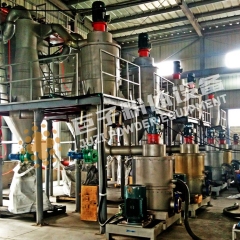
 Equipment Display