- Products
-
Shops
AI Search

High-frequency ultrasonic vibrationUsing high-frequency ultrasonic vibration (typically 20-50 kHz), it generates powerful cavitation effects and micro-jet impact forces, enabling efficient and fine dispersion, emulsification, and nanoscale processing.。
Precise Energy ControlPossessing precise energy control capability, it achieves sub-micron homogenization with uniform particle size distribution (D50=150nm, CV<5%), forming a thermodynamically stable nanoemulsion.。
Microfluidic shear forceWhen the bubble collapses, it generates a high-speed liquid jet (velocity >200 m/s), with shear forces reaching up to 10⁷ s⁻¹, far exceeding those of high-pressure homogenizers (10⁵ s⁻¹), effectively deagglomerating nanoparticles.。
Adaptive Constant Amplitude SystemEquipped with a constant-amplitude variable output circuit, it can monitor load impedance in real time and automatically compensate for energy output, unaffected by thermal expansion, sudden viscosity changes, or pressure fluctuations, with amplitude fluctuation <±3%, ensuring stable dispersion results.。
Dynamic Pulse Temperature Control SystemUsing pulse mode (work/pause ratio 1:1), the temperature rise can be controlled within ±2°C, preventing the inactivation of heat-sensitive components (such as vitamin C and peptides), with a bioactivity retention rate of >95%.。
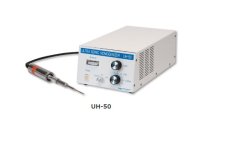
Lightweight designThe vibrator weighs approximately 160g, and the main unit features a lightweight design, allowing for direct handheld operation on micro-reactors/centrifuge tubes.。
Food industryCan be used for lactose/ghee emulsification, sauce stability optimization, powdered milk processing, carbonated beverage micro-foaming technology, etc., to improve texture and stability.。
In the field of medicine and healthcare.Suitable for nanomedicine preparation, liposome/exosome drug loading, mRNA vaccine delivery systems, etc., to improve drug bioavailability and stability.。
The cosmetics industryIt can be used for preparing nanoemulsion systems, dispersing sunscreen agents, and reconstituting freeze-dried essences, thereby improving the delivery efficiency of active ingredients.。
New Materials and Energy SectorIt can be used for lithium battery slurry dispersion, nanofluid thermal conductive agents, 3D printing ceramic slurries, etc., breaking material agglomeration and achieving high solid content, low viscosity slurries.。
Laboratory-grade precision processingCompatible with PCR tubes and 96-well plates, suitable for high-throughput screening (e.g., preparation of drug sustained-release microspheres), with a minimum processing volume as low as 0.1 mL.。
Modular probe designProvides a variety of probe configurations, such as the φ3mm titanium alloy probe suitable for high-viscosity systems, and the φ10mm glass probe for low-viscosity transparent solutions. It also offers optional vacuum degassing modules and online monitoring systems.。
Micro-quantitative processing capability*Small 0.1mL processing capacity, supports 96-well plate experiments, lightweight main unit for easy handheld operation.。
*Small processing volume:0.1mL。
Particle size control range:50nm-10μm。
Energy density:100-500W/cm²。
Temperature rise control±2℃ (Pulse Mode)。
Energy efficiency0.3 kWh/kg, saving 62.5% energy compared to traditional equipment.。
R&D sideSave 90% of sample volume and shorten 50% of process development cycle.。
Production sideUnit energy consumption decreased by 62.5%, and the pass rate increased to 99% (particle size CV < 5%).。
Quality control endCompliant with FDA/EMA Nanomedicine Guidelines (Stable within Zeta Potential ±30 mV)。