- Products
-
Shops
AI Search

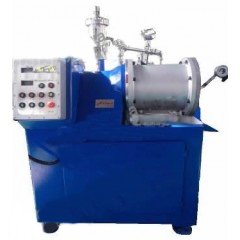
Technical Data:
grinding cylinder | The material of the rod pin. | Grinding shaft | Separation system (mm) | The lining material of the grinding cylinder. | Cylinder Seal | grinding media |
with cooling | Imported hard alloy wear-resistant rod pins | Stainless steel | High-flow dynamic separator 30μm -0.5mm | DIN Special Wear-Resistant Steel | Imported double-end face mechanical seal | Zirconia beads |
Basic data:
Grinding Volume (L) | Processing batch (L) | Speed (r/min) | Drive power (kW) | Fineness (nm) | Length (mm) | Width (mm) | Height (mm) | Weight (kg) |
25L | 500-2000 | 700-1000 | 45 | ≤50 | 1900 | 960 | 1800 | 2000 |
Working principle
The material enters the grinding chamber from the top via the feed pump and is evenly distributed as the rotor rotates. Under the action of eddy current centrifugal force within the gaps between the rotor and stator, the material undergoes thorough pre-dispersion treatment. In the subsequent intense grinding process, the rotor pins and stator continuously generate剧烈的撞击 changes on the grinding media, which in turn act on the material, enabling it to be ground. The ground material has an extremely short residence time in the grinding chamber, resulting in a very narrow particle size distribution range. Under the pressure of the feed pump and centrifugal force, due to differences in density, the grinding media return to the grinding chamber, while the material moves in the opposite direction of the centrifugal force, passing through the dynamic separator for filtration and separation, in a continuous cycle.
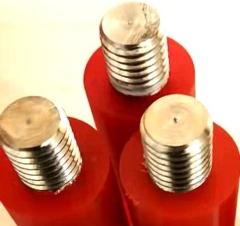
Structural Design: The core design features imported wear-resistant steel rod pins installed on the rotor, with their quantity, volume, and installation positions engineered according to vortex fluid dynamics. This achieves an optimized **grinding ratio and grinding energy**, enhancing material grinding efficiency and enabling the material to reach a nanoscale fineness. As measured by a third-party Malvern laser particle size analyzer, the minimum fineness can reach ≤50nm.