- Products
-
Shops
AI Search

Chromium powder is a light-resistant and heat-resistant coating material. It can also be used as an abrasive, a coloring agent for glass and ceramics, and a catalyst for chemical synthesis.Chrome alum and dichromates are used as tanning agents for leather, mordants and impregnating agents for fabric dyeing, as well as various pigments.Chromium plating and chromizing can form a corrosion-resistant surface layer on metals such as steel, copper, and aluminum, while also providing a bright and attractive appearance. They are widely used in industries such as furniture, automotive, and construction.In addition, chromium ore is also widely used in the production of refractory materials. It can also be used in powder metallurgy, diamond tools, electrical alloys, welding materials, aluminum alloy additives, and more.
| Physical and Chemical Properties | Appearance: Silver-white metal with a slightly dark gray tint (body-centered cubic crystal system). Melting point (1857±20)°C Boiling point: 2672°C Relative density 7.20℃ Solubility: Soluble in dilute sulfuric acid and hydrochloric acid, insoluble in water, nitric acid, and aqua regia. |
Meanwhile, chromium has been listed as one of the *important electroplating metals. In most cases, the chromium coating is specifically used as the *outer layer of parts. During chromium plating, the thinner the chromium layer, the more tightly it adheres to the metal surface. For example, the inner walls of some artillery barrels and gun barrels have a chromium layer only 0.005 millimeters thick, yet after thousands of shells and bullets are fired, the chromium layer remains intact. Without the physical properties provided by the chromium coating, the service life of most parts would be significantly shortened due to wear, corrosion, and other factors, requiring frequent replacement or repair. Therefore, chromium electroplating is increasingly widely used in many industrial manufacturing processes.
Features of the Equipment
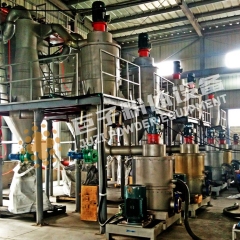
1. Low energy consumption: It integrates centrifugal crushing, impact crushing, and extrusion crushing, achieving energy savings of up to 40–50% compared to other types of mechanical crushers.
2. High fineness: Equipped with a self-classifying grading system, the product fineness is adjustable from 60 to 2000 mesh.
3. Wide feeding range: The feeding particle size is ≤3mm, and the material only needs to undergo coarse crushing equipment.
4. Low Wear: The wear-prone parts in the crushing section are made of new wear-resistant materials such as hard alloys, ensuring a long service life.
5. Strong mechanical stability: capable of 24-hour continuous production without downtime.
6. Full functionality:
Capable of crushing needle-like materials, achieving a finished product aspect ratio of 15:1.
The crushing process involves no temperature rise, making it suitable for crushing heat-sensitive materials.
It can perform dispersion operations on sintered and agglomerated ultrafine materials, with a particle size recovery rate of;
With particle shaping functionality, effectively increasing packing density.
Material capable of crushing fibrous tissue;
It can crush materials with high moisture content and has a drying function.
Can crush materials with strong stickiness.
7. Negative pressure production ensures no dust pollution and an excellent working environment.
8. High degree of automation, strong stability, and easy operation.