- Products
-
Shops
AI Search
Microfluidic chips are the primary platform for implementing microfluidic technology. With the chip as the operational platform, based on analytical chemistry, supported by micro-electromechanical processing technology, characterized by microchannel networks, and currently primarily applied in life sciences, they represent a key focus in the development of micro total analysis systems. Their goal is to integrate the entire laboratory's functions—including sampling, dilution, reagent addition, reaction, separation, and detection—onto a microchip, which can be reused multiple times.
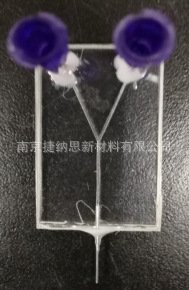
Microfluidic chips can be customized with different mixing channel structures, such as "Y"-shaped channel chips, "cross"-shaped channel chips, and reaction-type chips.
Typical applications: 1. Biological research 2. Clinical diagnostic instruments 3. In vitro bionic models 4. Organic synthesis 5. Microreactors 6. Chemical analysis 7. Rheology research, etc.
The main characteristic of microfluidic chips is that their effective structures for accommodating fluid flow (such as channels, reaction chambers, and other functional components) are at least in the micrometer scale in one dimension. They are fabricated with high precision using advanced etching techniques, offering features such as controllable liquid flow rates, minimal consumption of samples and reagents, and analysis speeds that are tens to hundreds of times faster.
Can be customized according to user requirements.