- Products
-
Shops
AI Search

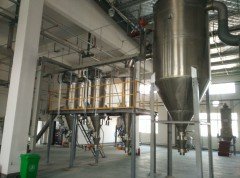
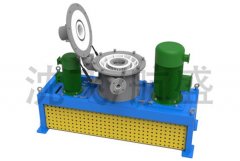
Various ultra-fine powder system integrated production lines
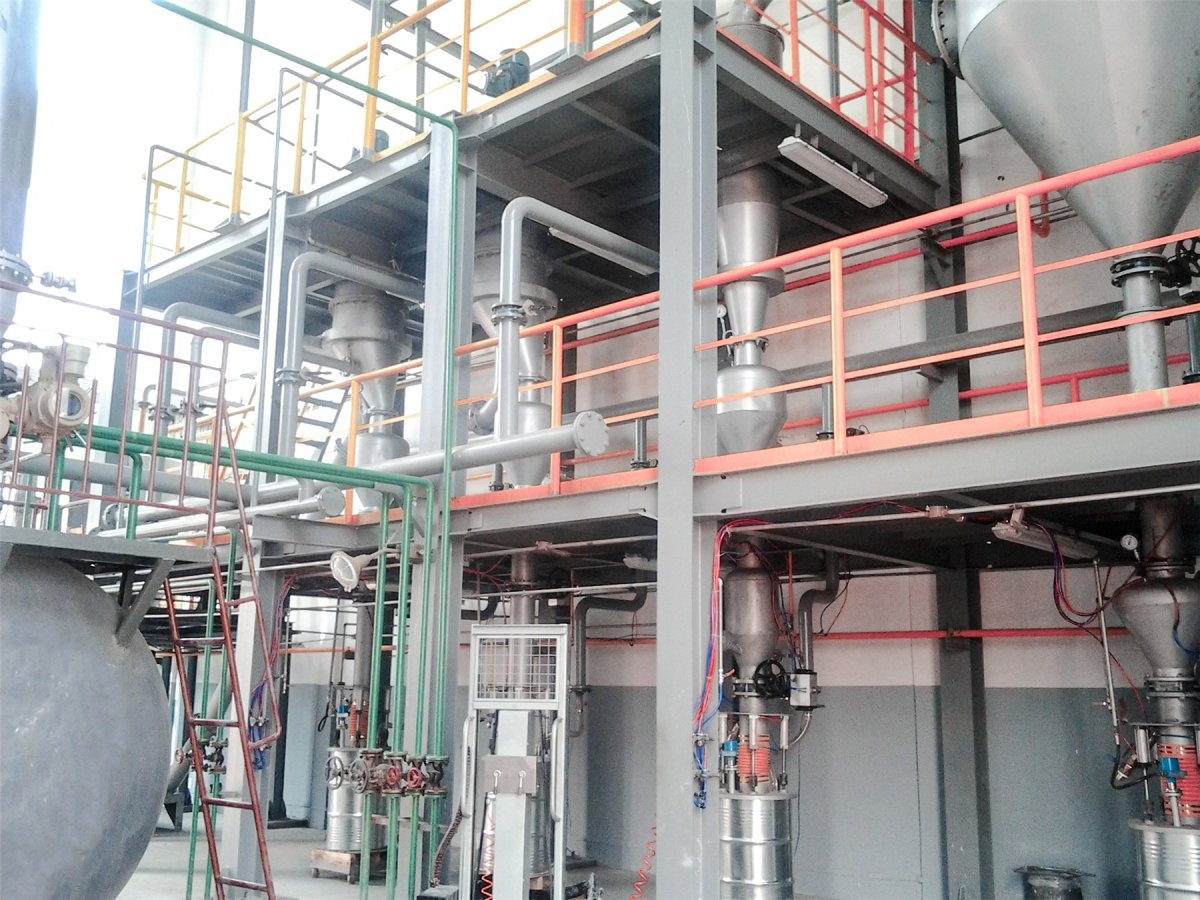
Working Principle:
The classifier, dust collector, and induced draft fan form a classification system. Under the suction force of the fan, materials move rapidly from the feed inlet at the lower end of the classifier into the classification zone along with the rising airflow. In this zone, the strong centrifugal force generated by the high-speed rotating classification vortex separates coarse and fine materials. Fine particles meeting the required particle size pass through the gaps between the classifier wheel blades and are collected by a cyclone separator or dust collector. Coarse particles, along with some fine particles, lose their velocity upon colliding with the wall, descend along the cylinder wall to the secondary air inlet, and undergo intense elutriation by the secondary air, resulting in the separation of coarse and fine particles. Fine particles rise to the classification zone for secondary classification, while coarse particles descend to the discharge outlet for removal.
Equipment Performance Features:
1. Using a completely dry production process without water or washing, it is possible to obtain abrasive micro-powders with a narrower particle size distribution and no contamination. A single classification can produce products of any grade according to current domestic and international standards (e.g., Chinese standard W63 to W3.5, Japanese standard 240# to 3000#, and European standard F230/53 to F1200/3). The yield rate for a single grade exceeds 75%.
2. High classification precision, more accurate cut particle size, lower required rotational speed, and long service life.
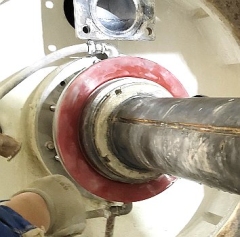
3. Independent cast iron bearing housing, permanently deformation-free, with a long service life.
4. Optimized transmission design, with low bearing load and long service life.
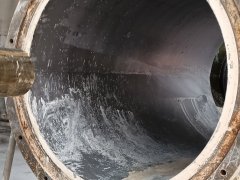
5. Unique pipeline design facilitates powder flow, reduces wear, and ensures that wear-prone areas are easy to replace and maintain.
6. The company's unique variable frequency feeding system facilitates material dispersion, ensures continuous, uniform, and stable feeding, and aids in product particle size control.
7. Unique internal circulation secondary air design, with adjustable grading cone clearance, significantly reduces air consumption, lowering grading energy consumption and ensuring thorough extraction of fine powder.
8. The separation of flow paths helps reduce wear at the bottom of the classification wheel and is more conducive to controlling larger particles.
9. Fully enclosed negative pressure operation, no dust pollution.
10. Good stability: once the fixed parameters are adjusted, stable production can be maintained.
11. In particular, the core competitive advantage of more thorough extraction of fine powders and excellent stability has been widely recognized by the industry.
12. The entire system adopts automated control, enabling one-key start/stop, making operation simple and convenient. When connected to the central control, remote control can be achieved.
◆ General Applications:
The ZJ-F series precision air classifiers are capable of classifying materials that cannot be processed on conventional sorting equipment. They are particularly suitable for processing products with strict particle size requirements and narrow particle size distribution, such as ground calcium carbonate, kaolin, talc powder, barite powder, copier toner, coatings, mica, graphite, auxin, aluminum hydroxide, and more.
◆ High-purity applications:
The ZJ-F series precision airflow classifier is suitable for materials with extremely strict impurity content requirements or those highly sensitive to iron contamination, while also meeting the demands for particle size and particle size distribution. Typical materials include phosphors, titanium dioxide, starch, silica gel, aluminum, copper, luminescent powders, and various high-purity pigments.
◆ Abrasives and hard materials
The ZJ-F series precision airflow classifier is capable of ultra-fine classification of hard materials with a Mohs hardness of 7 or above. The application of a vertical vortex classifier minimizes equipment wear. The rotational speed of the classification wheel is adjustable, allowing for optimized selection of crushing parameters. When multiple classifiers are combined, narrow-band classification across several particle size ranges can be achieved in a single operation. Typical products include diamond, silicon carbide, boron carbide, tungsten carbide, special ceramics, and emery, among others.
◆ Food, health supplements, and pharmaceuticals:
The ZJ-F series precision airflow classifiers are capable of ultra-fine processing of pharmaceuticals, food, and health products. Their features, including low-temperature grinding, high-purity operation, high processing smoothness, and easy cleaning, make the ZJ-F series ideal for use in the pharmaceutical, health product, and food industries. These features not only enhance the bioavailability and efficacy of drugs but also reduce production costs. Typical products include pollen, hawthorn, shiitake mushrooms, pearl powder, stomach medications, nimodipine, antibiotic drugs, contrast agents, reishi mushrooms, Chinese gallnuts, and fleeceflower root.
◆ Other industries:
The ZJ-F series precision air classifiers can operate in a closed-loop system with inert gases to classify materials that are highly prone to combustion, oxidation, or explosion. Examples include carbonyl iron powder, nickel powder, tungsten-cobalt alloy powder, and refined selenium powder.