- Products
-
Shops
AI Search

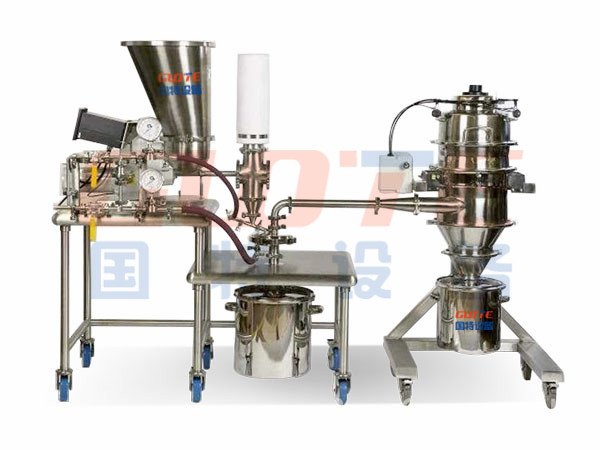
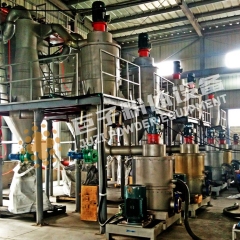
Product Name: Cyclonic Air Jet Mill
Feed particle size:≤3mm
Production capacity20-10000kg/h
Application Areas: Widely used in industries such as chemicals, mining, abrasives, refractory materials, battery materials, metallurgy, building materials, pharmaceuticals, ceramics, food, pesticides, feed, new materials, and environmental protection, as well as for ultra-fine grinding, dispersion, and particle shaping of various dry powder materials.
Materials: silica powder, calcium carbonate, feldspar powder, aluminum oxide, bauxite, kaolin, talc, graphite, etc.
Equipment Introduction: The cyclone-type jet mill is a new type of jet mill independently developed by our company with proprietary intellectual property rights. Its introduction has addressed the shortcomings of high energy consumption and low output in jet mills. It is an upgraded product replacing opposed jet mills and fluidized bed jet mills, with technical performance fully surpassing similar products both domestically and internationally.
Highlight advantages:
With the same energy consumption, the output is higher than that of ordinary jet mills.1 times.
2. Configure a self-classification grading system with a narrow product particle size distribution, and the service life of the grading wheel is 5 to 8 times longer than that of horizontal or vertical grading wheels.
3. Wide feed particle size range, with a **feed particle size of up to 5mm**.
4. It is not only used for ultra-fine grinding but also has the functions of particle shaping and particle dispersion.
5. For flammable, explosive, or easily oxidized materials, inert gas can be used as a medium to achieve closed-circuit crushing. The inert gas is recycled, resulting in extremely low losses.
6. Low-temperature, medium-free crushing, especially suitable for ultra-fine grinding of low-melting-point and heat-sensitive materials.
7. Extremely low wear, making it especially suitable for ultra-fine grinding of materials with high hardness and high purity.
8. The equipment has a compact structure, with polished inner and outer walls. The crushing chamber has no material accumulation, no dead corners, is easy to clean, and meets GMP requirements.
9. Negative pressure production ensures no dust pollution and an excellent working environment.
10. Automatic control, simple operation, and stable operation.
Working Principle Introduction: Compressed air, after cooling, filtration, and drying, forms a supersonic airflow through a nozzle and enters a rotating grinding chamber, fluidizing the material. Inside the rotating grinding chamber, the accelerated material converges at the intersection points of the airflow jets from multiple nozzles, resulting in intense collisions, friction, and shearing, achieving ultra-fine grinding of the particles. The ground material is transported upward by the rising airflow to the impeller classification zone. Under the combined action of the centrifugal force of the classification wheel and the suction force of the fan, coarse and fine powders are separated. The coarse powder returns to the grinding chamber under its own gravity for further grinding, while the qualified fine powder enters a cyclone collector with the airflow. Micro-fine dust is collected by a bag filter, and the purified gas is discharged by an induced draft fan.