- Products
-
Shops
AI Search

**Product Introduction:**
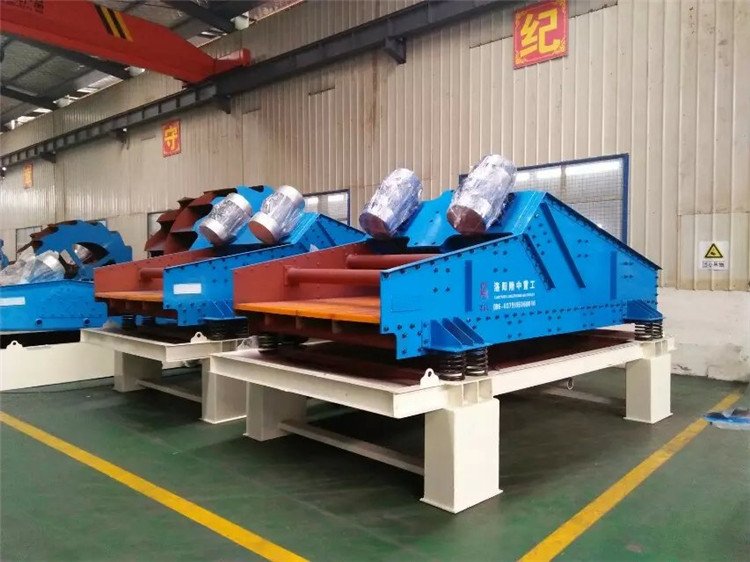
The linear dewatering screen is a large-scale screening equipment developed by our company in recent years. It is suitable for material separation processes in new energy industries such as raw coal dewatering, classification, dewatering in coal preparation plants, mine screening, power plant screening, and coal chemical industry. With a linear motion mode, the material is less likely to clog the screen holes, and the screen plate has a longer service life than traditional circular vibrating screens, making it an upgrade from traditional circular vibrating screens.
Application Areas:
Dewatering screens are primarily used for tailings dewatering in the mineral processing industry, coal slurry dewatering in coal preparation plants, dewatering of washed quartz sand, and dewatering of ceramic slurry.
Lightweight and durable.
The main frame body is constructed using a combination of riveting and welding of steel components, resulting in a structure that is free of internal stress, high in strength, lightweight, and durable.
Long wear life, customizable.
High-wear-resistant screen panels have a long service life. Their modular assembly design makes replacement easy and cost-effective, and the screen hole size can be selected according to requirements.
V-shaped screen surface design
Professionally designed frequency, amplitude, and low-energy power source, suitable for various dewatering needs with 24-hour continuous dry discharge operation. V-shaped screen surface design, -5° climbing dewatering across the screen surface, resulting in low moisture content in dry-discharge tailings, high efficiency, and large processing capacity per unit area.
New Dry Discharge Dewatering Process
The new dry dewatering process, compared to traditional processes, features lower investment, a simpler flow, and a smaller footprint, making it convenient for system process layout.
Dual-motor drive
Uses a waterproof, frequency-adapted dedicated motor with dual-motor drive self-synchronization technology to achieve efficient dewatering results.
Working principle
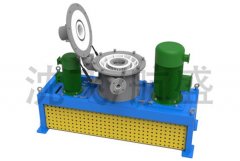
The linear dewatering screen adopts dual-motor self-synchronization technology, universal eccentric blocks, and an adjustable amplitude vibrator. It mainly consists of a screen box, an exciter, a support system, and a motor. The two independent vibrators are driven synchronously in opposite directions through belt couplings. The centrifugal forces generated by the two sets of eccentric masses are superimposed along the vibration direction, while the opposite centrifugal forces cancel each other out, resulting in a single exciting force along the vibration direction, causing the screen box to perform reciprocating linear motion.
A dewatering screen, also known as a high-frequency dewatering screen, alters the surface tension of the slurry through excitation force. The slurry water passes through the screen mesh to become underflow, while fine materials are retained by the screen mesh, forming a filter layer that moves forward and is discharged under the influence of vibration force. Dewatering screens are primarily used in the mining industry for tailings dewatering, in coal preparation plants for coal slime dewatering, in the dewatering of washed quartz sand and ceramic slurry, as well as in industries such as power generation, sugar production, and salt manufacturing for dry and wet classification, dewatering, desliming, and medium removal of medium and fine particle materials.