- Products
-
Shops
AI Search

Working Principle:
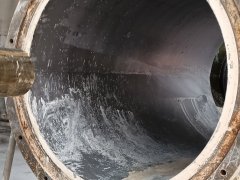
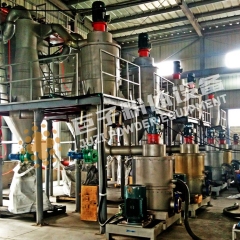
After the material undergoes crushing and iron removal, it is evenly fed into the mill chamber by the lifting and conveying equipment through the hollow shaft at the feed end of the ball mill. The chamber is lined with quartz or corundum plates and contains quartz or corundum balls of various specifications. As the cylinder rotates, centrifugal force lifts the grinding media to a certain height, causing them to fall and impact and grind the material. The powdered material that meets the required fineness is discharged through the discharge grate, completing the grinding process. The fine powder from the ball mill enters the airflow classifier through the feeding system of the classifier under the suction force of the induced draft fan. After being fully dispersed inside the classifier, it reaches the classification zone. In this zone, the material is subjected to the dual action of centrifugal force generated by the rotating classification rotor and the suction force of the induced draft fan. Finer particles, experiencing less centrifugal force than the suction force of the induced draft fan, pass through the gaps of the rotor blades and enter the cyclone collector and pulse dust collector for collection as finished products. Coarser particles, experiencing greater centrifugal force than the suction force of the induced draft fan, are thrown to the inner wall of the classifier, lose speed, and slide down to the lower part of the classifier for discharge. The coarse material discharged from the lower part of the classifier is directly returned to the ball mill for further grinding in the next cycle. The entire system operates as a closed-loop system under negative pressure, ensuring no dust pollution. The gas discharged by the induced draft fan is clean gas that meets environmental protection requirements.
Performance Features:
The outstanding features of this ultrafine ball mill classification production line are the significant progress and breakthroughs achieved in energy-saving technology, environmental protection, classification precision, and equipment lifespan, representing the **level** of current ball mill classification technology.
1. Through the optimized configuration of ball milling and classification equipment, the energy consumption of the production line has been significantly reduced.
2. The production line allows for one-time classification with adjustable fineness ranging from 200 to 2500 mesh. With the addition of an ultra-fine classification unit, the fineness can reach 3000 to 5000 mesh, achieving the **leading level** of domestic dry classification. This resolves the current limitation where only two sets of classification equipment could be used for producing ultra-fine products.
3. The ultra-fine ball mill features an innovative design based on existing ball mills, resulting in reduced equipment power consumption, a more scientific and reasonable grinding media ratio, and significantly improved grinding efficiency. It can effectively produce ultra-fine powders and adjust the particle size distribution of the finished product as required.
4. Based on existing classification equipment, improvements and innovative designs have been made. By innovating and altering the structural form of the classification chamber, the sealing structure of the classification impeller, the impeller material, and the structural form of the secondary air in the equipment, the equipment's lifespan has been effectively improved. This results in high classification efficiency, excellent classification precision, and accurate cut points, resolving the issue of severe product tailing in the original classification equipment.