- Products
-
Shops
AI Search

Technical Features
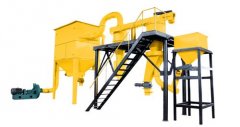
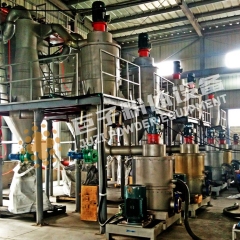
The entire classification system consists of an airflow classifier, a cyclone collector, a pulse dust collector, a high-pressure induced draft fan, and an electric control cabinet. The airflow classifier is a forced-type classifier equipped with a secondary air inlet and a vertically installed large impeller rotor. During operation, materials enter from the lower cylinder under the suction force of the induced draft fan. The external primary air fully mixes with the materials, allowing the particles to be thoroughly dispersed and rise to the classification zone. Due to the high-speed rotation of the classification impeller rotor, the particles are subjected to both the centrifugal force generated by the rotation of the classification impeller and the centripetal force produced by the suction of the induced draft fan. When the centrifugal force acting on the particles exceeds the centripetal force, coarse particles above the classification diameter are thrown toward the inner wall of the cylinder, lose speed, and slide down along the wall. The external secondary air enters through evenly distributed air inlets on the cone, creating an air-screening effect on the coarse particles to separate fine powders mixed or adhered to the coarse material. The separated coarse material is collected and discharged from the classifier by a discharge device. Fine particles below the classification diameter, along with the gas-solid two-phase flow, enter the cyclone collector and pulse dust collector for collection. The purified gas is then discharged by the induced draft fan.
Main Features:
The classifier structure has been specially designed to almost completely block all large particles, ensuring high classification accuracy and strict control over large particles.
The classification point can be freely adjusted through the rotational speed of the classifying impeller and the air volume of the induced draft fan to obtain the desired product, offering a wide classification range.
The vertical single-impeller classification structure with low rotational speed ensures a stable material flow field, high processing capacity, and efficient classification performance.
A multi-stage series structure can be adopted to simultaneously classify several particle size segments, achieving an ideal particle size distribution.
Process Flow Diagram
1. Storage bin 2. Operating platform 3. Classifier 4. Cyclone collector 5. Pulse dust collector 6. High-pressure induced draft fan 7. Electric control cabinet
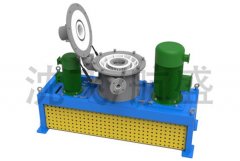
Institutional schematic diagram:
Technical Parameters: