- Products
-
Shops
AI Search

Working Principle:
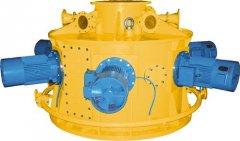
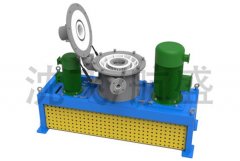
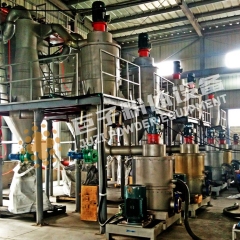
The classifier, cyclone separator, dust collector, and induced draft fan form a classification system. Under the suction force of the fan, materials move rapidly from the feed inlet at the lower end of the classifier into the classification zone along with the rising airflow. In this zone, the strong centrifugal force generated by the high-speed rotating classification turbine separates coarse and fine materials. Fine particles meeting the required particle size pass through the gaps between the blades of the classification wheel and enter the cyclone separator or dust collector for collection. Coarse particles, along with some fine particles, lose their velocity upon impacting the wall, descend along the cylinder wall to the secondary air inlet, and undergo intense elutriation by the secondary air, resulting in the separation of coarse and fine particles. Fine particles rise to the classification zone for secondary classification, while coarse particles descend to the discharge outlet for removal.
Performance Features:
The particle size of the graded product can reach D97: 3 to 150 microns, with stepless adjustable particle size, making product variety switching extremely convenient.
The classification efficiency (extraction rate) ranges from 60% to 90%. The classification efficiency is related to the material properties and the content of particles that meet the required particle size. If the material has good fluidity and a high content of particles meeting the required particle size, the classification efficiency is high; otherwise, it is low.
High rotational speed ensures precise apex cutting, and multiple classifiers can be connected in series to simultaneously produce products across multiple particle size ranges.
The control system adopts program control, with real-time display of operating status for easy operation.
The system operates under negative pressure, with dust emissions not exceeding 40 mg/m³. Equipment noise, through the use of soundproofing measures, is no higher than 75 dB(A).
Principle Structure Diagram:
1. Motor 2. Classifying wheel 3. Fine material outlet 4. Chamber 5. Secondary air inlet 6. Coarse material inlet
Technical Parameters: