- Products
-
Shops
AI Search

Working principle
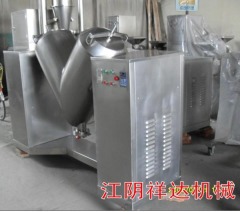
The multifunctional V-type mixer is a novel and efficient equipment for mixing powdered and granular materials. By rotating the container around its central axis, the materials inside the machine move along with the container, continuously changing positions, undergoing shearing and diffusion, thereby achieving uniform mixing. The V-type dry powder and particle mixer is primarily used in industries such as chemical, food, pharmaceutical, feed, ceramics, and metallurgy for the uniform mixing of powdered, granular, and similar materials. This machine features a reasonable and simple structure, sealed operation, and convenient material loading and unloading (manual or vacuum feeding). The drum is made of stainless steel, making it easy to clean.
Structural characteristics
1. Due to the circular motion of the mixing drum, the materials are essentially free from centrifugal force, resulting in no specific gravity segregation, stratification, or accumulation. Components can have significant weight ratios, with a mixing rate of over 99%, making it one of the ideal products among mixer types.
2. High cylinder loading rate, high efficiency, and short mixing time.
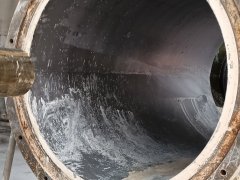
3. The cylinder body features smooth arc transitions throughout, with both the inner and outer surfaces meticulously polished for an aesthetically pleasing appearance.
4. Smooth and reliable operation with minimal vibration, easy to operate and maintain.
5. The V-type mixer can utilize vacuum suction for material feeding, operate in a sealed state, and has no rotating mechanisms inside, making it clean, hygienic, and free of dead corners.
Technical Parameters
Model/Model number | Total volume m³ | Charge amount (kg) | mm long | mm | Center height mm | Outlet diameter (mm) | Discharge port height (mm) | Rotation total height mm | Mixing time min | Cylinder speed r/min | Transmission motor power (kW) | Machine weight kg |
300L | 0.3 | 75 | 1900 | 600 | 1750 | Φ100 | 600 | 1900 | 6~10 | 12 | 1.1 | 350 |
500L | 0.5 | 125 | 2300 | 700 | 2100 | Φ150 | 580 | 2250 | 6~10 | 12 | 1.5 | 550 |
1000L | 1 | 250 | 2700 | 1000 | 2500 | Φ150 | 550 | 2700 | 6~10 | 10 | 2.2 | 1000 |
1500L | 1.5 | 325 | 3000 | 1000 | 2600 | Φ200 | 580 | 2900 | 6~10 | 10 | 3.0 | 1100 |
2000L | 2 | 500 | 3200 | 1200 | 3100 | Φ200 | 580 | 3250 | 6~10 | 8 | 4.0 | 1500 |
2500L | 2.5 | 625 | 3950 | 1500 | 3550 | Φ200 | 580 | 3800 | 6~10 | 8 | 5.5 | 1700 |
3000L | 3 | 750 | 4100 | 1500 | 3600 | Φ200 | 600 | 3850 | 6~10 | 8 | 7.5 | 1800 |
Note: The loading coefficient is 0.4. The production capacity in this table is calculated based on a loading coefficient of 0.4 and a material density of 0.6.