- Products
-
Shops
AI Search

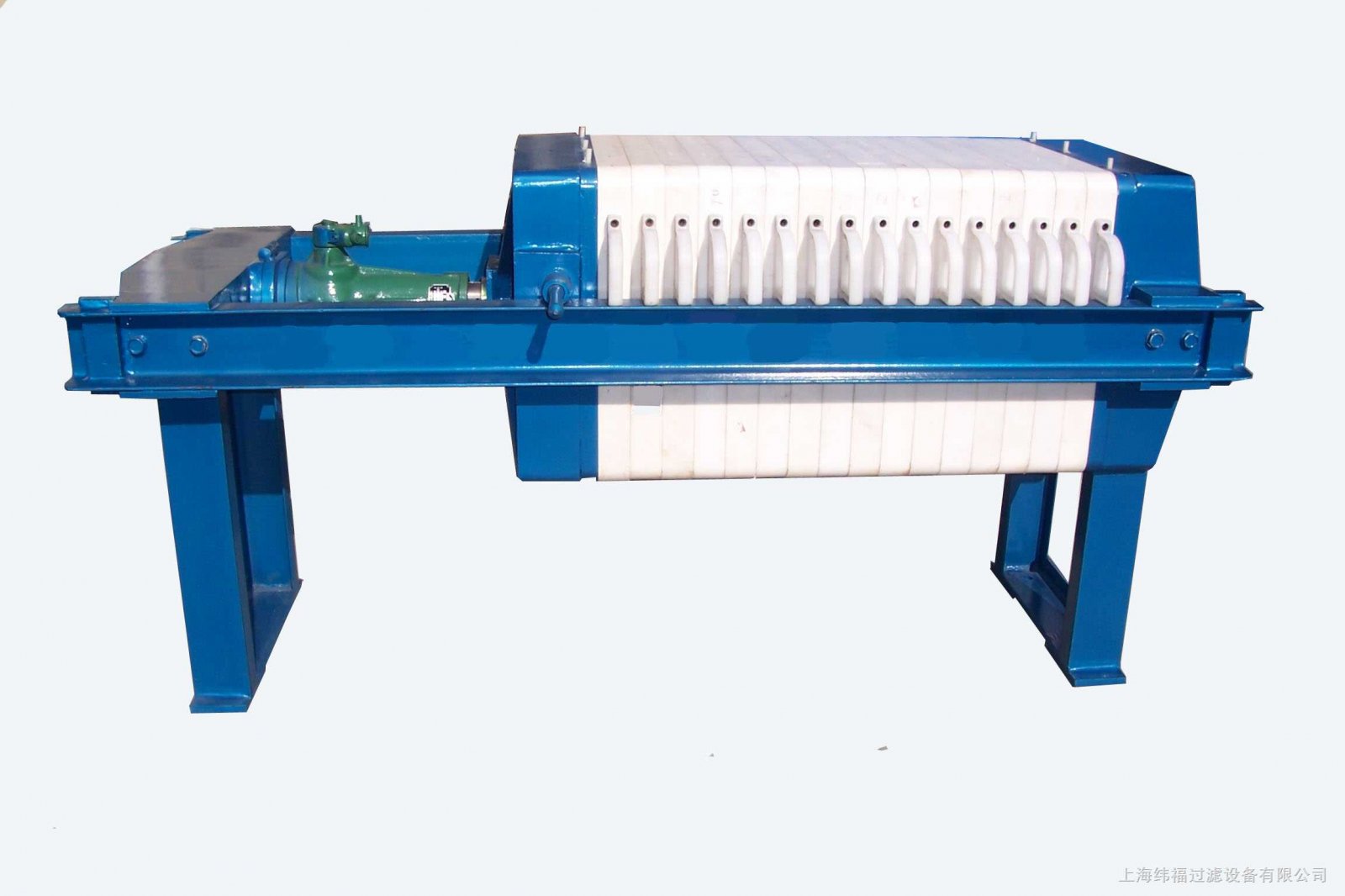
The plate-and-frame filter press is a highly mature dewatering equipment, widely used in sludge dewatering projects in Europe and the United States. The plate-and-frame filter press from Guangdong Jinkai Flooring arranges filter plates and filter frames with filtrate passages in parallel and alternating order. Each set of filter plates and frames is sandwiched with filter cloth, and the pressing end tightens the plates and frames to form a filter chamber between them. Sludge flows in from the feed inlet, water is discharged through the filter plates via the filtrate outlet, and the mud cake accumulates on the filter cloth within the frame. Once the filter plates and frames are loosened, the mud cake can be easily removed. This equipment offers advantages such as simple operation, high solid content in the filter cake, and strong applicability.
Characteristics
Plate-and-frame filter presses are suitable for suspensions with high compressibility or near-incompressibility of the filter cake. The solid particle concentration of the applicable suspension is generally below 10%, and the operating pressure is typically 0.3 to 1.6 MPa, with special cases reaching 3 MPa or higher. The filtration area can be adjusted by increasing or decreasing the number of plates and frames. The plates and frames are usually square, with the inner side length of the filter frame ranging from 200 to 2000 mm, the frame thickness ranging from 16 to 80 mm, and the filtration area ranging from 1 to 1200 m². The plates and frames are pressed together using manual screw, electric screw, or hydraulic methods. They are made from materials such as wood, cast iron, cast steel, stainless steel, polypropylene, and rubber.
The plate-and-frame filter press has a large equipment weight and volume. This type of sludge dewatering machine operates intermittently, with a production capacity of 50 kg/h of solids, resulting in relatively low productivity. However, it achieves a high dewatering rate, with the moisture content of the sludge cake reaching 70%-85%. Additionally, this equipment requires dedicated personnel for supervision and has poor automation; it has many moving parts, leading to instability; the equipment investment is relatively low; maintenance is difficult; operation is relatively complex and requires specialized management; and it has a short service life.
Component
The plate-and-frame filter press mainly consists of fixed plates, filter frames, filter plates, a pressing plate, and a pressing device, with an appearance similar to that of a chamber filter press. The materials used for manufacturing the plates and frames include metal, wood, engineering plastics, and rubber, among others. Various forms of grooves on the surface of the filter plates serve as drainage channels, while the filter frames are hollow. Multiple filter plates and filter frames are arranged alternately, with a filter medium (such as filter cloth) sandwiched between the plates and frames. The filter frames and filter plates are supported on two parallel horizontal beams by two lugs, with one end being the fixed plate and the other end being the pressing plate, which is tightened or loosened by the pressing device during operation. The filter press feeds material and discharges filtrate through channels at the corners of the plates and frames or through hanging lug channels extending from both sides of the plates and frames. The filtrate discharge method is divided into two types: open flow and closed flow. During the filtration process, the filter cake accumulates inside the frames. Generally, the working pressure of a plate-and-frame filter press is 0.3~0.5 MPa, while the working pressure of a filter press is 1~2 MPa.
Advantages and Disadvantages of Plate and Frame Filter Press
The drawbacks of the plate-and-frame filter press include that the feed port of the filter frame is prone to clogging, the filter cake is difficult to remove, it cannot operate continuously, the processing capacity is small, the working pressure is low, ordinary square plates made of standard materials are not pressure-resistant and prone to breakage, the filter cloth consumption is high, the plate-and-frame system is difficult to operate unattended, and the filter cloth often requires manual cleaning.
The advantages of the plate-and-frame filter press are: simple structure, easy operation, stable operation, and convenient maintenance; flexible selection range of filtration area with minimal floor space; strong adaptability to materials, making it suitable for various small and medium-sized sludge dewatering treatment applications.
Selection of Plate-and-Frame Filter Press
When selecting a filter press model, it is essential to understand the nature of the material to be filtered, the daily volume of the material, and its solid content. Estimate the required filtration area and total filter chamber volume, then refer to the performance parameter table provided by the manufacturer to choose the appropriate filter press model. Alternatively, consult the manufacturer's staff for professional selection advice.
(1) The specifications of filter presses include: 320, 450, 630, 800, 920, 1000, 1250, 1500, 1600, 1500X2000, 2000, as well as various special-shaped filter plates and press plates.
(2) Filter area **up to 2000 mm²**
(3) The filter plate materials include cast iron, rubber, reinforced polypropylene (plastic), glass fiber polypropylene, etc.
(4) The flow forms include open flow, closed flow, washable, non-washable, and various feed modes such as center feed, corner feed, and top-center feed.
(5) The filter plate pressing methods include: manual screw pressing, electric mechanical pressing, and hydraulic cylinder pressing. For filter presses with special requirements, alternative solutions can be negotiated separately.
(6) Optional features include automatic plate pulling, automatic liquid receiving flap, explosion-proof, and programmable control functions.